Matlabo wrote:
Any help is deeply appreciated.
Do you have a working test bench for that design?
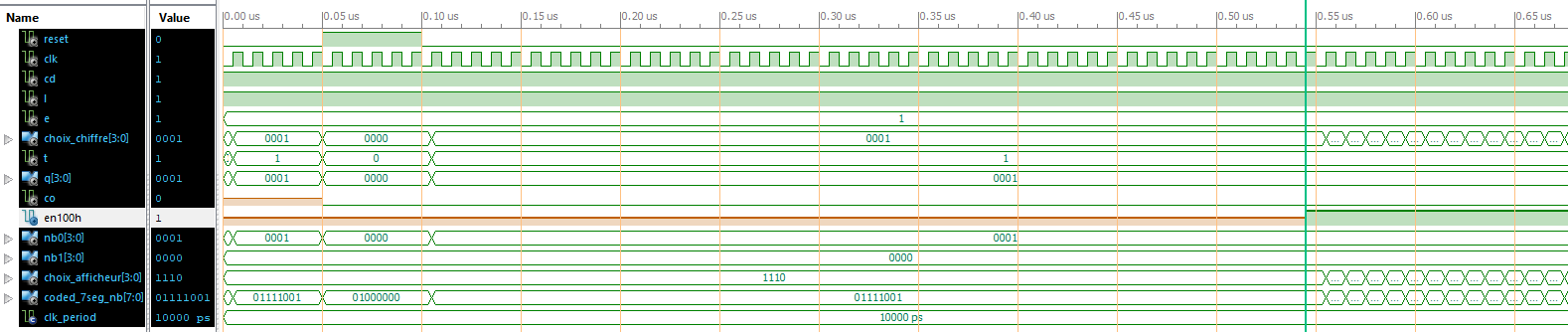
I made one and it does not schow anything making any kind of sense to me...
Matlabo wrote:
P.S2: I am running the simulation on ISE and it takes too much time. Any
tips in order to reduce the simulation time ?
You must speed up your clock enables:
1 |
architecture Behavioral of diviseur is
|
2 |
:
|
3 |
elsif rising_edge (Clk) then
|
4 |
-- if qt=50000000 then
|
5 |
if qt=4999 then
|
6 |
enlh <='1' ;
|
7 |
:
|
8 |
-- if qt100 = 500000 then
|
9 |
if qt100 = 49 then
|
10 |
en100h <= '1';
|
11 |
:
|
12 |
end process;
|
13 |
end Behavioral;
|
50000000 ... 500000
The usual "off-by-one" problem: with a compare value of 500000 you count 500001 clock cycles. Considering that it is very crude to handle the ones and hundreds by two separate prescalers:
1 |
elsif rising_edge (Clk) then
|
2 |
if qt=50000000 then
|
3 |
enlh <='1' ;
|
4 |
qt := 0;
|
5 |
else enlh <= '0' ;
|
6 |
qt := qt+1 ;
|
7 |
end if;
|
8 |
|
9 |
if qt100 = 500000 then
|
10 |
en100h <= '1';
|
11 |
qt100 := 0;
|
12 |
else
|
13 |
qt100 := qt100 + 1;
|
14 |
end if;
|
15 |
|
16 |
|
17 |
end if;
|
Why don't you handle the digits in a way every "usual" counter does:
when the ones reach 9, then with the next clock the tens are incremented and the ones are reset to 0. When the tens reach 9 then with the next clock the hundreds are incremented and the tens are reset. And so on...
Have a look at the code of the stop watch there:
http://www.lothar-miller.de/s9y/archives/88-VHDL-vs.-Verilog-am-Beispiel-einer-Stoppuhr.html
Its German, try Google translator.
BTW:
1 |
use IEEE. numeric_STD.ALL;
|
2 |
use IEEE.STD_LOGIC_UNSIGNED.ALL;
|
Never ever both of them together! The numeric_std has all you need.
With both of them you will now and then encounter weird error messages due to double definitions of some data types.
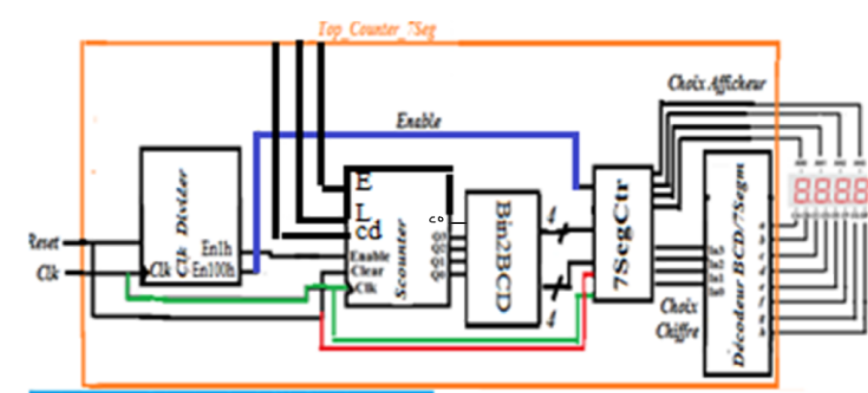
 schema.png
(120 KB)
schema.png
(120 KB)