Signal clock generator

OP #7320909
Rate this post
useful
not useful

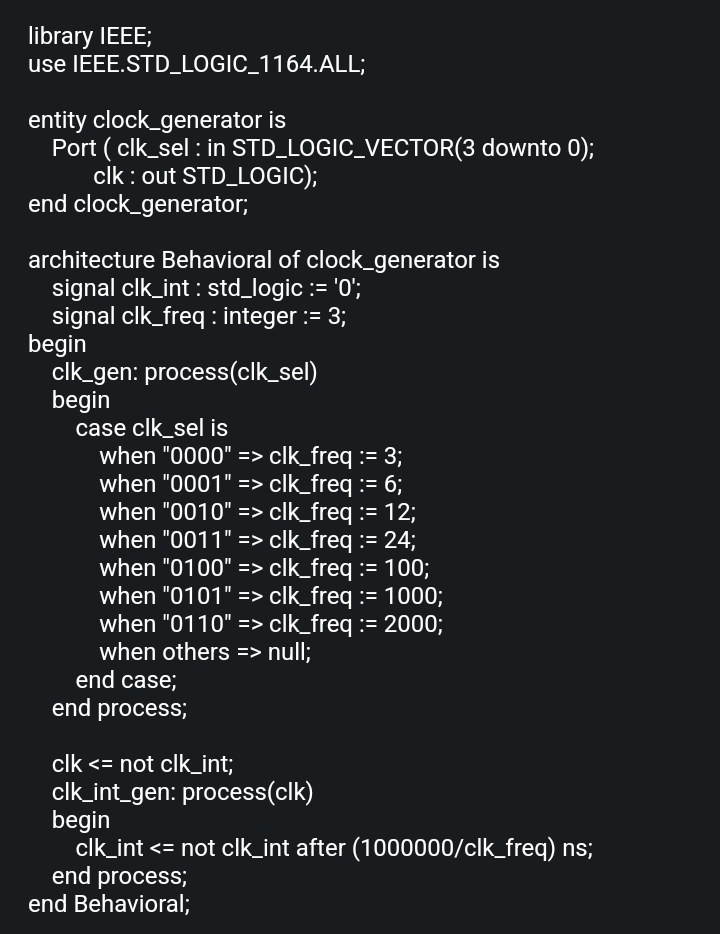
Hello everyone, I am new to VHDL so basically I need help with vhdl code that I have to do till friday for college. I'm working in Xilinx ISE (dev sys is E2LP)

"Design a clock signal generator circuit. Using switches on the development system, the frequency of the clock signal should be able to be selected as: 3 Hz, 6 Hz, 12 Hz, 24 Hz, 100 Hz, 1000 Hz and 2000 Hz."

So I have been working on solution but I'm not sure if it is going to work on E2LP. Any help is going to be appreciated

1
library IEEE;
2
use IEEE.STD_LOGIC_1164.ALL;
3

4
entity clock_generator is
5
    Port ( clk_sel : in STD_LOGIC_VECTOR(3 downto 0);
6
           clk : out STD_LOGIC);
7
end clock_generator;
8

9
architecture Behavioral of clock_generator is
10
    signal clk_int : std_logic := '0';
11
    signal clk_freq : integer := 3;
12
begin
13
    clk_gen: process(clk_sel)
14
    begin
15
        case clk_sel is
16
            when "0000" => clk_freq := 3;
17
            when "0001" => clk_freq := 6;
18
            when "0010" => clk_freq := 12;
19
            when "0011" => clk_freq := 24;
20
            when "0100" => clk_freq := 100;
21
            when "0101" => clk_freq := 1000;
22
            when "0110" => clk_freq := 2000;
23
            when others => null;
24
        end case;
25
    end process;
26

27
    clk <= not clk_int;
28
    clk_int_gen: process(clk)
29
    begin
30
        clk_int <= not clk_int after (1000000/clk_freq) ns;
31
    end process;
32
end Behavioral;
Attached files:
Moderator (Company: Titel) #7321982
Rate this post
useful
not useful

Filip wrote:

not sure if it is going to work on E2LP

Give it a try. Start the synthesizer and look what happens.

But to go into future: it won't work. Simply because inside the FPGA isn't anything like a "variable drlay" like that you want to get with "after (1000000/clk_freq) ns;"

In your FPGA you will have to use flip-flops and logic (in the LUTs) to create a counter that counts some clock-cycles and toggles a flag after reaching a desired prescaler value.

With other words: why reenventing the wheel? Simply look how others did the job and try to understand what they did.

Reply

Please log in before posting.

or

Log in with Google account

Registration is free and takes only a minute.

Register now