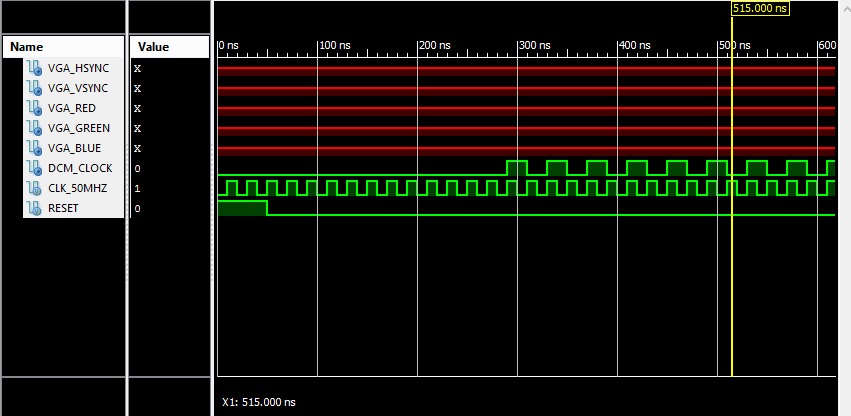
I am using a SPARTAN 3E and have used the DCM core to generate a 50 Mhz
to 25 Mhz clock to drive the VGA PORT.
The reset logic I'm using is shown here.

DigitalClockManager instance_name (
    .CLKIN_IN(CLK_50MHZ),
    .RST_IN(rst_in),
    .CLKFX_OUT(clk),         //25 Mhz
    .CLKIN_IBUFG_OUT(CLKIN_IBUFG_OUT),
    .CLK0_OUT(),
    .LOCKED_OUT(LOCKED),
    .STATUS_OUT(STATUS)
    );


  BUFG buffer (.I(CLKIN_IBUFG_OUT), .O(CLKIN));


  reg LOCKED_R;
  reg [3 : 0] SR;
  always @ (posedge CLKIN)
begin
  if(RESET)
  begin
  SR [3 : 0]  <= 4'b111;
  LOCKED_R <=0;
  end

  else
  begin
  LOCKED_R <= LOCKED;
  if(LOCKED < LOCKED_R | STATUS [1] )// H to L LOCKED | CLKIN UNSTABLE
  SR <= {1'b1 , SR[3 : 1]};
  else
  SR <= {1'b0 , SR[3 : 1]};
  end
end

assign rst_in    = ( (SR[2] | SR[1] | SR[0]) || RESET);


Now, I am not sure about how to implement reset for all the other
registers in the design, since they are driven by the DCM clock output.
If the RESET signal pulse lasts for a period shorter than what it takes
to assert the locked signal, (which probably will be the case because of
the OR gate at the rst_in), the registers will never be reset.

always @ (posedge clk)
begin
   if (LOCKED && !STATUS[1])
  begin
           //GOOD TO GO
  end
  else

  begin
   //RESET
  end
end

Does the always @ (posedge clk) trigger even when (LOCKED && !STATUS[1])
isn't high? If so, why does the simulation show everything inactive
until the locked bit doesn't go high?


BOTTOM LINE : How can I ensure that the else block triggers?
              Is the DCM RESET LOGIC I'm using right?
Attached files:
-
 questiondcmpic.jpg
(84 KB)
questiondcmpic.jpg
(84 KB)