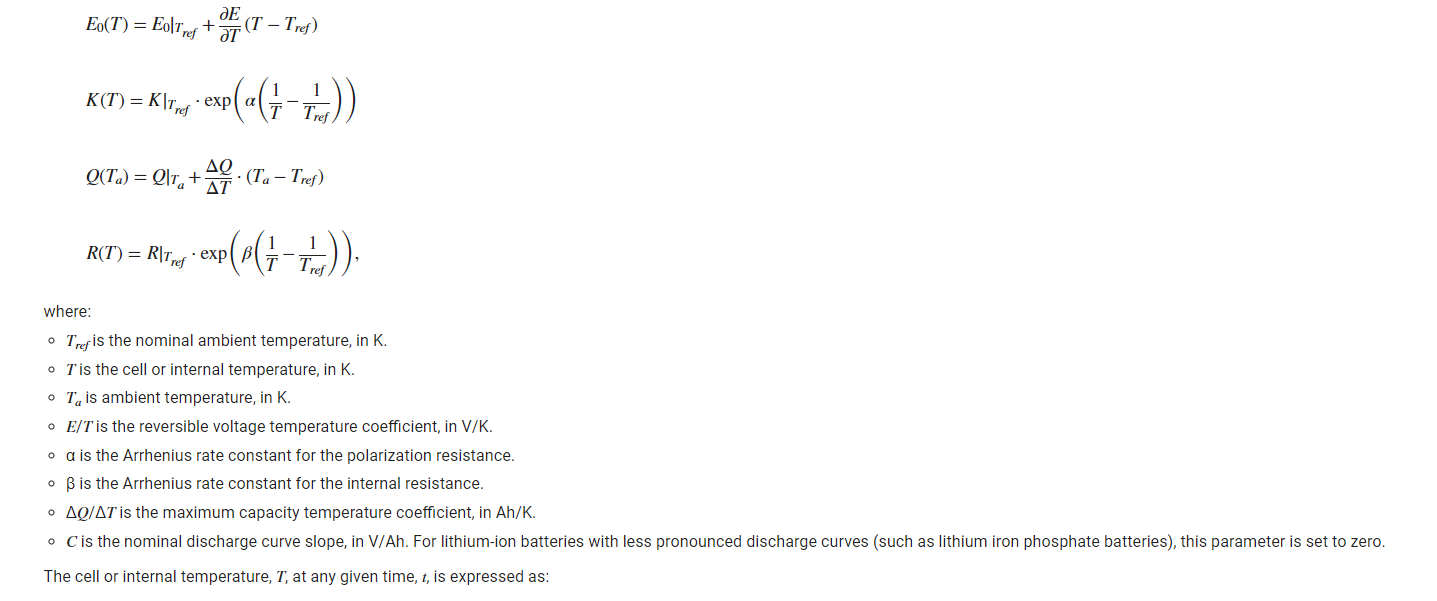
The Arrhenius constants α and β

Guest #7297105
Rate this post
• ▲ useful
▼ not useful
Well,

the ln is nothing else than the logarithm to the base e.

But if a logarithm has the same argument as its base, that is equal to 1 
by definition.

That means, divide K(T,ref) and R(T,ref) to switch it on left side.
Now multiplicate with ln (left and right side. That means for right side 
follwing facts:
ln^(e) = 1
1 × your alpha oder beta term. The alpha and beta part comes now out / 
down from exp. part.
For left side you have to consider the ln calculation rules: 
ln(R/R(T,ref)).
The Temperature terms on the right side can you easily handle with a 
division and you will get alpha and beta free.
I hope that helps you.
Guest #7297682
Rate this post
• ▲ useful
▼ not useful
Ah ok,.. for my understanding:

You should find out the R and K value over a thereotical estimation or 
lab trials. For my opinion: alpha and beta are open values which are 
maybe not further defined in Simulink. Well, more details are given in 
literature, or Simulink Help Section for a definition  of different 
battery material setups? But, i dont know it sure.

Reply

Note: the original post is older than 6 months. Please don't ask any new questions in this thread, but start a new one.

Formatting
  • [c]C-Code[/c]
  • [code]code in other languages, ASCII drawings[/code]
  • [math]formula (LaTeX syntax)[/math]
  • [[Title]] – link to an article
  • Link to another post: right-click its post ID (#8078628), copy the address, paste it into the text

More about formatting

Post long source code as an attachment, not in the text.

Already registered? Log in

Not shown to anyone. We send you a link; your post appears once you confirm it there.

By submitting you create a free account and accept the terms of use.