Clock frequency reducer

OP #7004717
Rate this post
• ▲ useful
▼ not useful
I am trying to divide my input clock signal by 10 - effectively setting 
my out HIGH 5 of ten clock pulses and LOW the other 5.

However, my counter idea does not work - the clk_ou2 signal doesn't 
update at all, and I do not know why.

1
library ieee;
2
use ieee.std_logic_1164.all;
3
use ieee.numeric_std.all;
4

5
entity Taktteiler is
6

7
port (
8
    clk_in : in std_logic;
9
    clk_out : out std_logic;
10
    reset : in std_logic
11
);
12
end Taktteiler;
13

14
architecture rtl of Taktteiler is
15

16
signal counter : unsigned(3 downto 0);
17
signal clk_out2 : std_logic := '0';
18

19
begin
20
process(clk_in)
21
    begin
22
        if(rising_edge(clk_in)) then
23
            counter <= counter + 1;
24
            if std_logic_vector(counter) = "101" then --reset the counter at 101
25
                counter <= (others => '0');
26
                clk_out2 <= clk_out2 XOR '1'; --toggle the out2 signal
27
            end if;
28
        end if;
29
        if reset = '1' then --reset on HIGH reset input
30
            counter <= (others => '0');
31
            clk_out2 <= '0';
32
        end if;
33
end process;
34
clk_out <= clk_out2;
35
end architecture rtl;
Guest #7004767
Rate this post
• ▲ useful
▼ not useful
counter is a 4 bit vector. It can never be equal to "101", because that 
ist a 3 bit vector. So std_logic_vector(counter) = "101" will never be 
true...

Try to replace line 24 by
    if counter="0101" then

If it works, then check, if you really divide by 10 or by some other 
value..
Guest #7004941
Rate this post
• ▲ useful
▼ not useful
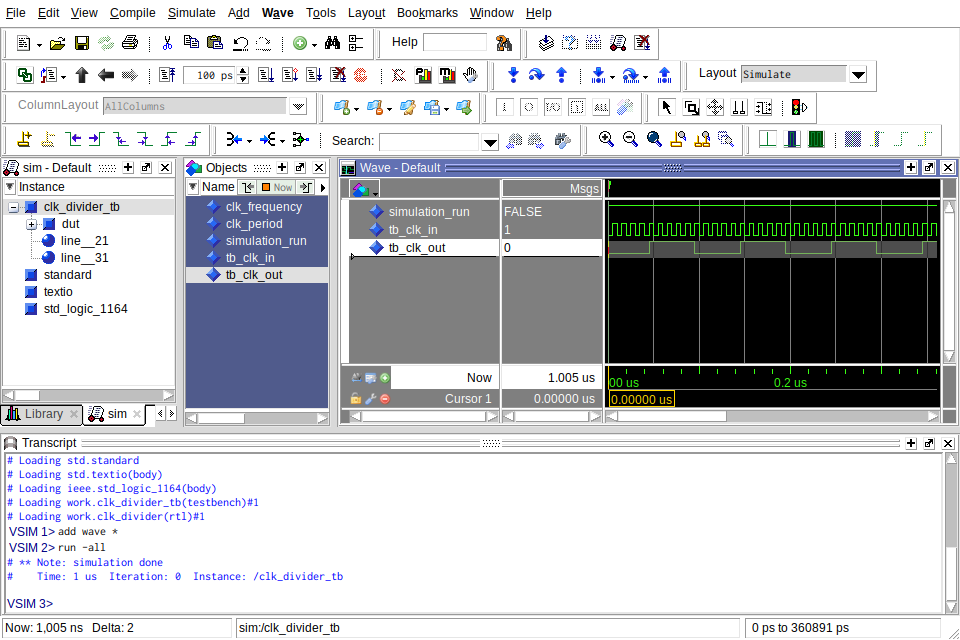
I prefer a simple solution with just a single shift register:
1
library ieee;
2
use ieee.std_logic_1164.all;
3

4
entity clk_divider is
5
    port
6
    (
7
        clk_in  : in  std_logic;
8
        clk_out : out std_logic
9
    );
10
end entity clk_divider;
11

12
architecture rtl of clk_divider is
13

14
    signal clk_reg : std_logic_vector( 9 downto 0) := "0000011111";
15

16
begin
17
    
18
    process
19
    begin
20
        wait until rising_edge( clk_in);
21
        clk_reg <= clk_reg( clk_reg'high-1 downto 0) & clk_reg( clk_reg'high);
22
    end process;
23

24
    clk_out <= clk_reg( clk_reg'high);
25

26
end architecture rtl;

Duke
Attached files:
Moderator (Company: Titel) #7005063
Rate this post
• ▲ useful
▼ not useful
Eric J. wrote:
> signal counter : unsigned(3 downto 0);
Achim S. wrote:
> counter is a 4 bit vector. It can never be equal to "101"
To get rid of such kind of problems I would use an integer range 0 to 9 
for counting.
Then the compare for 0 and 5 is easily human readable:
1
:
2
signal counter : unsigned(3 downto 0);
3
:
4
:
5
   process(clk_in)
6
   begin
7
      if(rising_edge(clk_in)) then
8
         if counter<9 then counter <= counter + 1;
9
         else              counter <= 0;
10
         end if;   
11
         if counter = 0 then clk_out <= '0'; end if;
12
         if counter = 5 then clk_out <= '1'; end if;
13
   end process;
14
:

Duke Scarring wrote:
> I prefer a simple solution with just a single shift register
I prefer the very same without any process ;-)
1
library ieee;
2
use ieee.std_logic_1164.all;
3

4
entity clk_divider is
5
    port ( clk_in  : in  std_logic;
6
           clk_out : out std_logic);
7
end entity clk_divider;
8

9
architecture rtl of clk_divider is
10
    signal clk_reg : std_logic_vector(9 downto 0) := "0000011111";
11
begin
12
    clk_reg <= clk_reg(8 downto 0) & clk_reg(9) when rising_edge(clk_in);
13
    clk_out <= clk_reg(9);
14
end architecture rtl;

Reply

Note: the original post is older than 6 months. Please don't ask any new questions in this thread, but start a new one.

Formatting
  • [c]C-Code[/c]
  • [vhdl]VHDL-Code[/vhdl]
  • [code]code in other languages, ASCII drawings[/code]
  • [math]formula (LaTeX syntax)[/math]
  • [[Title]] – link to an article
  • Link to another post: right-click its post ID (#8078628), copy the address, paste it into the text

More about formatting

Post long source code as an attachment, not in the text.

Already registered? Log in

Not shown to anyone. We send you a link; your post appears once you confirm it there.

By submitting you create a free account and accept the terms of use.