-
Article
STM32
im Stop Modus STM32L0 (2014) ARM Cortex M0+ bis 32 MHz - mit EEPROM STM32L1 (2010) ARM Cortex M3 bis 32 MHz - mit EEPROM STM32U0 (2024) ARM Cortex M0+ bis 56 MHz STM32L4 (2015) ARM Cortex M4F bis 80 MHz STM32U3 (2025
Anwendungen STM32F0 (2013) ARM Cortex M0 bis 48 MHz STM32C0 (2022) ARM Cortex M0+ bis 48 MHz - billig STM32G0 (2018) ARM Cortex M0+ bis 64 MHz STM32F1 (2007) ARM Cortex M3 bis 72 MHz - die älteste STM32 Serie STM32F3
-
Article
Diskussion:STM32
Moin, wäre eine Tabelle für die stm32 MCUs unter Umständen übersichtlicher? Die Darstellung als eine Lange Liste wirkt etwas unübersichtlich. Bei der Tabelle bin ich mir nicht sicher ob es optimal wäre, aber so finde ich es auch etwas
-
Article
Linux auf STM32
Für dem Einsatz von Linux bzw. ucLinux eignen sich derzeit inbesondere folgende HW-Platformen: STM32F429I Discovery STM32F7 Discovery Folgendes youtube video zeigt beim STM32F429I Discovery die Verwendung des Displays mit touch und der seriellen Schnittstelle. Dieses Linux-Image kann z.B. unter einem
) Linux-Host wie folgt erstellt und auf das Board installiert werden clone repository git clone cd stm32f429-linux-builder/ git checkout MovingTux cd .. install toolchain wget sudo tar -xjf arm-2010q1-189-arm-uclinuxeabi-i686-pc-linux-gnu.tar.bz2 sudo apt-get install genromfs install openocd git clone
-
Article
STM32 für Einsteiger
Prozessorfamilien kostenlose und leistungsfähige Software. Aktuell (2022) ist für den Einstieg die STM32CubeIDE und STM32CubeMX zu empfehlen. STM32CubeIDE ist die IDE für die SW Entwicklung in C und C++ inkl. Debugging. STM32CubeMX ist ein grafisches Tool zur Konfiguration des Controllers (IO's, Timer
ist mir zu groß, gibt es eine Alternative? - Ja, "Der 10-polige JTAG Stecker von mmvisual" = Links = STM32 Hauptartikel, dortige Linksammlung Anleitung: STM32 Eclipse Installation Anleitung: STM32 Anleitungen und ein kleines Buch für den Einstieg Diskussion: Totzeitrechner für STM32
-
Article
STM32 Breakout Board
STM32 mit diesem Chips verbunden. Spannungsversorgung: LF33CD. Die Spannungsversorgung (3,3V Betriebsspannung für STM32 und FT231X) erfolgt über den LF33CD im TO-220 Gehäuse von ST. Ebenfalls zu samplen
Größe 0603) an CBUS3 des FT231X (muss konfiguriert werden) Led 1,2,3 (Größe 0805) an PC13,14,15 des STM32. Multipurpose
-
Article
STM32 Eclipse Installation
OpenOCD und LD Linker-Datei src: die eigenen Quellcodes makefile Das Projekt wurde geschrieben für den STM32F103RC (256K Flash/48K RAM), läuft aber auch mit einem STM32F103xB da der Stack-Pointer auf 20K initialisiert wird. Details stehen in der Datei "src/stm32f10x_vector.c", Zeile 29,30: Damit wird der
Dennoch hilft es die Peripherie einfacher planen zu können. Weblinks, Foren, Communities. Artikel STM32 Artikel STM32 CooCox Installation Thread zu diesem Thema
-
Thread
STM32 and SMBus
Hello everyone, I am trying to communicate with a MAX11068 from a STM32F103 over SMBus, but it does not work as expected. Has anybody worked with the SMBus and would be so kind to provide sample code? Michael
-
Thread
STM32-MAT/TARGET
Hi, I am trying to generate sine modulated PWM on STM32F401-Disco board using MATLAB. The desired freq of a sine wave is 50Hz and of the carrier wave is 20kHz. But I am not getting 50Hz freq. Please suggest a solution. I need sine modulated PWM
-
Article
USB-Tutorial mit STM32
in der Software passiert. Für komplexe USB-Geräte oder eine schnelle Implementierung sei auf die im STM32CubeF1 enthaltene Bibliothek verwiesen. Es wird Grundlagenwissen über die Programmierung der STM32-Controller und über die C++-Programmierung vorausgesetzt. Zunächst wird ein "USB Hello-World" entwickelt
USB High Speed (480 MBit/Sec). Hier wird ein Controller mit der einfachsten Variante gewählt, der STM32F103RB. Dieser ist beispielsweise auf dem Olimexino-STM32 zu finden, im Folgenden wird dieses als Grundlage für die Beispiele genutzt. Der auf den günstigen Blue Pill-Boards zu findende STM32F103C8
-
 Image
Image
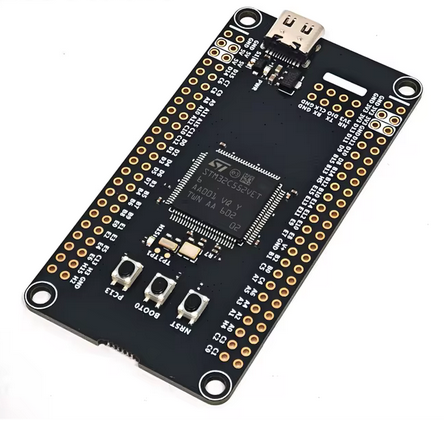
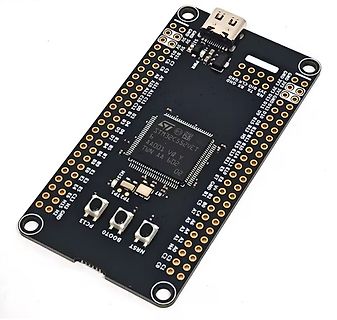
STM32 Mikrocontroller-Entwicklungsboard
STM32C552VET AA001 V4 Y TWIN AA 605 20 NRST BOOT0 PC13 GND 3V3 5V USB
-
Article
IRMP auf STM32 - Bauanleitung
die Distribution verfügbar ist, kann man es sich von holen. git clone git://github.com/j1rie/IRMP_STM32.git IRMP_STM32 cd IRMP_STM32 cd F103 ./make Firmware bauen (Windows). IRMP_STM32-master.zip herunter laden und auspacken in scripts prepare.bat ausführen IR.coproj in CooCox laden und kompilieren
im VDR als Power-Taste angelernt ist, kann man darüber den PC herunter fahren. Testen (Linux). Mit stm32IRconfig_gui: ST-Link anschliessen, stm32IRconfig_gui starten, "receive mode" drücken und testen. Mit stm32IRconfig: ST-Link anschliessen, stm32IRconfig starten, m eingeben für Monitor-Modus und testen
-
Article
STM32F4-Discovery
. Jetzt müssen noch 3 Dateien ins Projekt kopiert werden. /home/user/eclipse/STM32/STM32F4xx StdPeriphLib V1.0.0/Project/STM32F4xx_StdPeriph_Templates/TrueSTUDIO/STM324xG_EVAL/stm32_flash.ld /home/user/eclipse/STM32/STM32F4xx StdPeriphLib V1.0.0/Libraries/CMSIS/Device/ST/STM32F4xx/Source/Templates/system_stm32f4xx.c /home/user/eclipse/STM32/STM32F4xx StdPeriphLib V1.0.0/Libraries/CMSIS/Device/ST/STM32F4xx/Source/Templates/TrueSTUDIO/startup_stm32f4xx.s Die Dateiendung der Datei startup_stm32f4xx.s muss
-
Article
STM32 CooCox Installation
Bibliotheken aus dem Internet geladen und installiert werden. Zudem ist es von Vorteil wenn man bereits ein STM32F4DISCOVERY Board besitzt, denn das gezeigte Demo-Blink LED Programm nutzt dieses Board. Es kann natürlich auch jedes andere Board genutzt werden, das einen STM32F2xx oder STM32F4xx Prozessor beinhaltet
-Fachen Geschwindigkeit laufen. Damit die anderen ST-Lib Funktionen korrekt funktionieren muss in "stm32f4xx.h" folgenden Wert auf den Quarz geändert werden (Eingabe in Hz): = Weblinks, Foren, Communities = Artikel STM32 Artikel STM32 Eclipse Installation CoIDE und STM32F429
-
Thread
C++ STL and STM32
Hi, I have a problem with the C++ STL on the STM32. The following code works as expected on my hardware (chinese board with STM32F103..) [c] int main(void) { char Line[512]; std::list<std::string> *pHistory; pHistory = new std::list<
Hello Hase, I agree that I strain the stack a bit, but out of the 64k RAM in the STM32, I have less than 8k for .data and .bss sections. The remaining 56k are used for heap and stack. The initial stack pointer is set to the end of RAM and the heap grows upwards from the end of the .
-
Article
STM32F103C8T6 STM32 Billig Board
, Ebay & Co gibt es bereits ab 2 EUR (1.84€ [19.07.2017], 2.73€ [12.10.2024]) ein minimalistisches STM32-Board. Auf Ebay im Suchfeld Suchfeld einfach "STM32F103C8T6" eingeben. Eckdaten: STM32F103C8T6 64k Flash (viele C8 besitzen in wirklichkeit 128k Flash), 20k RAM Micro-USB, ISP Header (SWDIO) 8MHz
USB-Buchse kann man es sicher wie einen Arduino Nano direkt vom PC aus programmieren. Doch halt: Der STM32F103C8T6 kostet bei ST schon in 1000er Stückzahlen 3.40€. Auf den Boards ist also kein STM32F103C8T6 drauf sondern irgendeiner seiner chinesischen Clone oder gleich gar kein Chip im Gehäuse. Ausserdem
-
Article
Diskussion:STM32 für Einsteiger
Programmspeicher hat, dann sollte man erwähnen, dass es dann kein 8-Bit-PIC mehr ist. Denn die AVR32 können auch mehr als 256k... --Haku (Diskussion) 09:15, 31. Dez. 2013 (CET) = PIC?? = Warum sind da jetzt ganze Passagen über die Details der PIC's drin? Ist das nicht ein Artikel über STM32? Einen Artikel
/ Arduino. Der Artikel ist ziemlich zweifelhaft und erkennbar voreingenommen geschrieben von einem STM32-Fan. Falschaussagen sind auch vorhanden. Für AVR gibt es RTOSs aber für den Arduino nicht? Das muss mal erklärt werden, da der Arduino auch einen AVR nutzt.
-
Thread
Atomic write - STM32
Hi, I'm currently working with a STM32F4 and try to implement atomic access to variables (e.g. mutexes). Currently, I disable all interrupts before accessing a mutex, and enable them afterwards. Now there exist the LDREX and STREX commands on the STM32, which seem to be perfect for my application. But how do I use them correctly? In the manual it says that an STREX *must* have the same address as the previous LDREX. So I still need to disable interrupts
-
Article
STM32 jump to bootloader
STM32 - Jump To Bootloader In manchen Anwendungen möchte man keinen Hardwarebutton für ein Firmware-Update haben. Muss man trotzdem ab und zu ein Update einspielen, kann man den Bootloader über eine versteckte
ein kurzes Python-Script, welches "GBL\r" sendet und danach wird direkt das Flash-Update-Tool wie stm32flash aufgerufen. So entfällt jegliches Bedienen am Gerät. Das Python-Script heisst gbl.py, danach der Aufruf zum flashen: $ ./gbl.py && stm32flash -b 921600 -w output/main.bin -g 0x0 /dev/ttyUSB0
-
Article
Datei:Stm32 aufbau.jpg
STM32F103xC STM32F103xD STM32F103xE High-density performance line ARM-based 32-bit MCU
-
Article
Diskussion:STM32 Eclipse Installation
Könnte jmd herrausfinden, ob das ganze auch per ST Link mit den Eval Boards möglich ist?
-
Article
Datenuebertragung-STM32F4
Datenübertragung über 4 Datenleitungen. Zwei STM32F4 Discovery Boards sollen durch 4 parallele Datenleitungen und eine Steuerleitung, ähnlich der LCD-Implementierung, miteinander kommunizieren. An einem Board werden über eine PS/2 Tastatur Zeichen
-
Thread
WinARM support for STM32
I want to ask, if somebody use WinARM for the STM32 Cortex-M3? And I want to ask Martin Thomas about his plans about including working examples or, at least, examples of Makefile and *.ld files for the STM32 series microcontrollers in WinARM. I tried
Varuzhan Danielyan wrote: > I want to ask, if somebody use WinARM for the STM32 Cortex-M3? > And I want to ask Martin Thomas about his plans about including > working examples or, at least, examples of Makefile and *.ld files > for the STM32 series microcontrollers in WinARM
-
Thread
STM32 HAL Delay too slow
Hi, I recently started with an STM32F103C8T6 on a bluepill board. I am using SW4STM32 on Windows 10. When writing a program that blinks an LED on PC13 with the standard peripheral library and implementing my own SysTick_Handler
SystemCoreClock / 1000); } // My own SysTick_Handler void SysTick_Handler(void) { static uint32_t millis = 0; millis++; if (millis % 1000 == 0) { flipPin(); } } [/c] When I tried porting this code to a project using the Cube HAL libraries provided by SW4STM32 and using HAL_Delay
-
Thread
STM32 GDB on Mac OS
(GPIOx=0xa, PortVal=<optimized out>) at /l/arm/STM32F10x_StdPeriph_Lib_V3.5.0/Libraries/STM32F10x_StdPeriph_Driver/src/stm32f10x_gpio.c:423 423 /l/arm/STM32F10x_StdPeriph_Lib_V3.5.0/Libraries/STM32F10x_StdPeriph_Driver/src/stm32f10x_gpio.c: No such
with fixing this issue. Could someone advice on how to address this problem? I started by loading the STM32VL library into my project folder STM32 Template but the error persists. I don't understand why gdb is looking for thestm32f10x_gpio.c since the .elf file is already a compiled and ready to be loaded
-
Thread
STM32F103 math package
This is the overview of STM32F103 newly updated. It includes the clock tree of STM32F103 and more, hope it helps. https://www.embedic.com/technology/details/stm32f103
This is the overview of STM32F103 newly updated. https://get-9apps.com/web/ https://get-cartoonhd.com
-
Article
STM32 LEDBlinken AtollicTrueStudio
zwei Symbole zu definieren. STM32F10X_CL Definiert dass eine Controller aus der Connectin Line (STM32F107 oder STM32F105) verwendet wird. USE_STDPERIPH_DRIVER Definiert dass die Module für die STM32 Peripherie aus der STM32StdPerLib
\ST\STM32F10x\startup\TrueSTUDIO\startup_stm32f10x_cl.s In diesem Intro ist der StartupCode für einen Conection Line Controller in verwendung. Startupcodes für andere STM32 Controller Lines sind zu finden in
-
Article
STM32 Eclipse JLink Linux/Windows
muss die Datei "STM32F4xx_StdPeriph_Driver/src/stm32f4xx_fmc.c" gelöscht werden, wenn kein FMC vorhanden ist (wie beim STM32F40x), bzw. die "STM32F4xx_StdPeriph_Driver/src/stm32f4xx_fsmc.c" wenn kein FSMC vorhanden ist
/src/stm32f4xx_wwdg.c ./STM32F4xx_StdPeriph_Driver/src/stm32f4xx_usart.c ... ./STM32F4xx_StdPeriph_Driver/inc - Hier liegen die Includes für die Peripherie-Treiber ./STM32F4xx_StdPeriph_Driver/inc/stm32f4xx_wwdg.h
-
Article
STM32 - Einstieg mit Em::Blocks
die der Controller auch die entsprechende Peripherie bereit stellt. Diese Dateien dürfen nicht beim STM32F4-Discovery/STM32F407VG hinzugefügt werden. stm32f4xx_dma2d.c/.h stm32f4xx_fmc.c/.h stm32f4xx_ltdc.c/.h stm32f4xx_sai.c/.h Daraus resultiert folgende Struktur: Anschließend kann die Standard-Peripheral-Library
kann quasi als Basis für alle Projekte verwendet werden. Allerdings ist das Framework primär auf die STM32F405/7 und STM32F415/7 ausgelegt. Die neueren STM32F401, STM32F42X und STM32F43X haben noch etwas andere Peripherie, das Framework müsste dann entsprechend angepasst werden. Download: Einbinden der
-
Article
Diskussion:STM32F4-Discovery
Da es bereits eine allgemeine STM32 Seite gibt ( würde ich hier spezielle Informationen zum STM32F4, nach dem Titel sogar spezielle Informationen zu dem Board erwarten. So aber lese ich vieles, sicher nützliches, was eigentlich auf
bisher noch nichts mit GDB gemacht. Aber das wird schon werden. ---- Dann überarbeite doch die Seite (STM32_Eclipse_Installation). In Bezug auf die Seiten (STM32F4-Discovery) und (STM32) hast Du mich auch nicht überzeugt. Warum zwei Seiten nebeneinander die dann am Ende evtl. ineinander überführt werden
-
Article
STM32 F3 Discovery unter Linux
startup_stm32f30x.s von stmfw/stm32f3xx/Libraries/CMSIS/Device/ST/STM32F30x/Source/Templates/TrueSTUDIO nach stm32f3demo/ kopieren File editieren und die beiden Zeilen "bl SystemInit" und "bl __libc_init_array" in LoopFillZerobss auskommentieren. stm32f30x.h (aus stmfw/stm32f3xx/Libraries/CMSIS/Device/ST/STM32F30x/Include) nach stm32f3demo/fw/ kopieren File editieren und am Ende vom File #include "stm32_config.h"einfügen system_stm32f30x.c (z.B.
-
Article
STM32 USB-FS-Device Lib
STM32 USB-FS-Device Lib. Mit der STM32 USB-FS-Device Lib stellt ST C-Funktionen zur Benutzung der USB-Schnittstelle der STM32 µC zur Verfügung. Sie kann zusammen mit Beispielimplementationen verschiedener USB-Geräteklassen hier bei ST kostenlos heruntergeladen werden: STM32_USB-FS-Device_Lib_V3.3.0 STM32_USB-FS-Device_Lib_V4.0.0 Eine Beschreibung findet sich hier. Virtual COM Port. Für die allgemeine Kommunikation mit einem PC wird für die meisten Projekte ein Virtual
-
Thread
QSPI - STM32F7
Hello friends. I have a small problem with my QSPI on STM32F7. I connect memory on this pins. PB10 - CS flash PF8 - IO0 (SI) PF9 - IO1 (SO) PF10 - SCK And I call in main: [c] int main(void) { /* init NVICcm */ LL_Init(); /* init system clock
do you know when exactly you Need to check the WLE Bit? Assume you're using your Code for different STM32's with different clock Settings or something like that? That's the reason why I do it like posted above (multiple checks with timeout) makes more sense than to check the WLE just once. The same
-
Thread
STM32 Virtual COM Port driver
based on Windows XP. The driver (inf-file) described at: http://www.mikrocontroller.net/articles/STM32_USB-FS-Device_Lib and available at: http://www.mikrocontroller.net/articles/Datei:Stmcdc.inf works fine when the host is based on Windows 2000, but we can not find this inf-file on the ST web-pages
-
 Image
Image
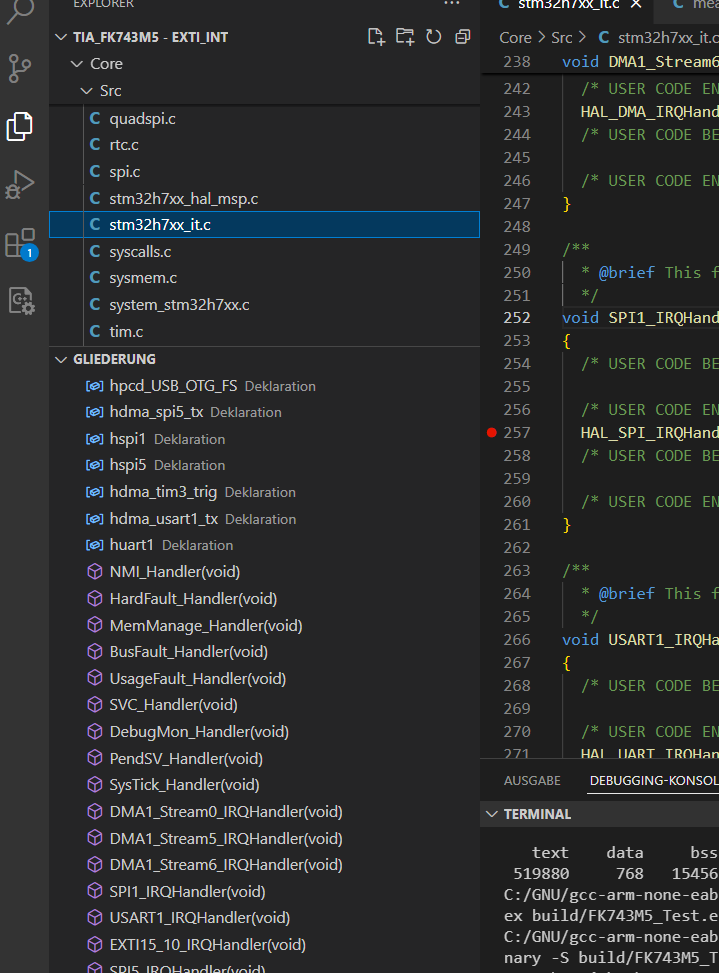
Code-Editor mit STM32 HAL-Treiberdateien
TIA_FK743M5 - EXTI_INT Core > Src > stm32h7xx_it.c quadspi.c rtc.c spi.c stm32h7xx_hal_msp.c stm32h7xx_it.c syscalls.c sysmem.c system_stm32h7xx.c tim.c GLIEDERUNG hpdc_USB_OTG_FS Deklaration hdma_spi5_tx Deklaration hspi1 Deklaration hspi5
-
Thread
STM32 UCOS/II GCC port
Hi All, We have use UCOS/II for different CPU, but now our customer are using an STM32 CPU on their new design. I would like to know if the GCC port has been done be someone else that Micrium ? The only port that I have seen on micrium is the IAR one. Regards Jonathan
-
Thread
STM32F401RE GPIO
Hi I'm asking for an assembly code for GPIO that have three LED with four switches .. each switch opens each LED.. I tried my code but only make s all the LED light up without the toggle..
-
Article
Datei:Eclipse STM32 Debugging.png
Debuggen eines STM32-Projekts in Eclipse
-
Article
Datei:Eclipse STM32 Project.png
Ein STM32-Beispielprojekt in Eclipse geöffnet.
-
Article
Datei:Olimexino STM32 USB.png
USB-Beschaltung des Olimexino-STM32. Autor: Olimex Lizenz: Creative Commons Attribution-ShareAlike 3.0 Unported License
-
Thread
Cool: STM32 CubeMX for Linux
It seems not (yet) being official announced by STM, but I've just discovered that the actual STM32 CubeMX V5.0.1 package contains an installer for Linux... https://www.st.com/en/ecosystems/stm32cube.html#overview ...and it works!
manually unpacked and started. It is even mentioned on https://www.mikrocontroller.net/articles/STM32#STM32CubeMX
-
Thread
First try STM32F4-Discovery
f ./cmsis/device/system_stm32f4xx.c.bak ./src/syscalls.c.bak ./src/main.c.ba k rm -f ./cmsis/device/system_stm32f4xx.lst ./src/syscalls.lst ./src/main.lst rm -f ./cmsis/device/startup_stm32f4xx.s.bak rm -f ./cmsis/device/startup_stm32f4xx.lst
ffunctio n-sections -fdata-sections -Wa,-ahlms=cmsis/device/system_stm32f4xx.lst -DRUN_ FROM_FLASH=0 -DVECT_TAB_SRAM -MD -MP -MF .dep/system_stm32f4xx.o.d -I . -I./inc -I./cmsis/core -I./cmsis/device cmsis/device/system_stm32f4xx.c -o cmsis/device/ system_stm32f4xx.o
-
Thread
STM32 ADC & DMA corrupted Values
Are you using an STMF103C8xx or STM32F103CBxx? I am asking because the web is full of negative reports about fake products with wrong data transferred by DMA.
happen ... i have to check. whats the outcome if there is an error? >Are you using an STMF103C8xx or STM32F103CBxx? I am asking because the >web is full of negative reports about fake products with wrong data >transferred by DMA. the mcus are from the STM32F0xx and STM32G4xx Family. they should
-
Thread
Problem with gnu ld and STM32
Hello, I'm trying to make anSTM32F103 work with the Code Sourcery tool chain. Using the attached ld command file, I get these errors: Invoking: Cross GCC Linker gcc -L"/home/Tommi/workspace/FWLib/Release" -Wl,-T ../SRC/STM32_Lnk.cmd -o "LED01" ./SRC/core_cm3.o ./SRC/main.o ./SRC/startup_stm32f10x_hd.o ./SRC/stm32f10x_it.o -lFWLib collect2: ld terminated with signal 11 [Segmentation fault] /home/Tommi/CodeSourcery/Sourcery_CodeBench_Lite_for_ARM_GNU_Linux/bin/../lib/gcc/arm-none-linux-gnueabi
-
Thread
OOCD with the STM32F103
Good day every one! I'm using the STM32F103 series in an embedded application, together with OOCD. Now the 1st setup: STM32 Evalboard by KEIL with the STM32 in a 64 Pinout and 64 K Flash (STM32F103R8T6) Amontec-JTAG-Key OOCD r423 and r717 Worked just great :-) The 2nd setup: STM32 now in my embedded app. and with 48 pinout 64 k flash (STM32F103C8T6) Amontec-JTAG-Key OOCD r423 and r717 Didn't work! :-( Well it did work sort of, that is, OOCD finds the two JTAG-Devices inside
-
Article
IRMP auf STM32 – stark vereinfachte Bauanleitung
auch per Fernbedienung mit dem Konfigurationsprogramm eingeben. Testen (Linux/Windows). Windows: Aus stm32IRconfig_gui.exe holen, Empfänger anschliessen, stm32IRconfig_gui starten, "receive mode" drücken und testen oder aus stm32IRconfig.exe holen, ST-Link anschliessen, stm32IRconfig starten, m eingeben
data as well via remote control with the configuration program. Testing (Linux/Windows). Windows: Get stm32IRconfig_gui.exe from , connect the receiver, start stm32IRconfig_gui, press "receive mode" and test or get stm32IRconfig.exe from , connect the receiver, start stm32IRconfig, enter m for monitor mode
-
Thread
STM32 stop mode wake via usart
The stm32 MCU wakes up with the internal 8Mhz oscilator and it takes some time to switch on HSE. Due to project-planning issues, does anyone know if it's possible to set a stm32 MCU in stop mode and force
transmitted USART data? see also: https://my.st.com/public/STe2ecommunities/mcu/Lists/ARM%20CortexM3%20STM32/Flat.aspx?RootFolder=%2Fpublic%2FSTe2ecommunities%2Fmcu%2FLists%2FARM%20CortexM3%20STM32%2Fwake%20up%20from%20stop%20mode%20on%20usart%20interrupt%20do%20I%20need%20to%20configure%20EXTI&FolderCTID
-
Thread
STM32F0 WITH STPM34
Hi everyone, I am working a project (stm32f0 with stpm34 ic measurement power). Could you help me interface stm32f0 with it. Thanks!
-
Thread
STM32F4 IMPRECISERR, trouble debugging
First off I did make a Debug Fault Handler, this is what I am getting r0 = 1200 0x000004B0 r1 = 0 0x00000000 r2 = 1200 0x000004B0 r3 = 1 0x00000001 r12 = 0 0x00000000 lr = 134228401 0x080029B1 pc = 134228410 0x080029BA psr = 553648128 0x21000000 OST = 536881104 0x200027D0 HFSR = 1073741824 0x40000000 CFSR = 1024 0x00000400 Showing BUSFAULT IMPRECISERR DFSR = 0 0x00000000 MMFAR = 3758157108 0xE000ED34 BFAR = 3758157112 0xE000ED38 AFSR = 0 0x00000000 PSP = 536881200 0x20002830 SHCSR = 0 0x00000000
-
Thread
STM32F303 Discovery: SPI basics
Hi, I try my first programming on an STM32 Discovery Board (STM32F303). I was using avrs before for years :-) First step should be to get the SPI to work. My IDE is Eclipse with gnu arm eclipse-plugin. All I want to see for now is the
-
Thread
STM32F130 and Timer 8
STM32F130 contains two adwanced timers - 1 and 8. But Keil's STM32_Init.c and its Configuration Wizard knows Timer 1 only. After "manual" programming it works but I cannot find its interrupts. How can I