-
Thread
Changing return address of exception
I am using olimex stm32 board. It has cortex-m3 processor. For my project, I require to change return address when processor is executing exception. I know that it is stored in stack, But where in stack? It is always
solved. I am writing the code to change return address which worked for me. This code is for olimex stm32f107 board. asm( "TST LR, #4;" "ITE EQ;" "MRSEQ R0, MSP;" "MRSNE R0, PSP;" ); asm("mov %0, r0" : "=r"(lraddr)); nxaddr=lraddr[12]; lraddr[12]=NEW
-
Thread
eLua on STM32F4discovery
Hi, i'm trying to run eLua on a STM32F4discovery board. I downloaded and flashed this image successfully: http://dd.homeunix.com/home/space.php?uid=1&do=blog&id=90 http://dd.homeunix.com/home/attachment/public-File/elua_lua_stm32f407vg
Hi; Does this mean you have done a STM32F4 build of v0.8 that supports ROMFS? Would you be willing to post the binary? Thanks, CZ
-
Thread
STM32F407 SPI reads wrong data
Hey, I'm encountering a strange problem with the hardware SPI of the STM32F407 [2] (discovery board). I'm trying to communicate with an UM7 IMU [1] over its SPI interface. When I try to read its firmware revision, I receive ASCII 'T71E' instead of the expected 'U71D'
E'. To me at least it looks like the data is transmitted correctly by the UM7, but somehow the STM reads the last bit incorrectly. The behavior is reproducible, i.e. the first and last byte always have the last bit flipped. Are there any pitfalls for the STM SPI I should aware of? Or am I doing
-
Article
STM32 Breakout Board
STM32 mit diesem Chips verbunden. Spannungsversorgung: LF33CD. Die Spannungsversorgung (3,3V Betriebsspannung für STM32 und FT231X) erfolgt über den LF33CD im TO-220 Gehäuse von ST. Ebenfalls zu samplen
Größe 0603) an CBUS3 des FT231X (muss konfiguriert werden) Led 1,2,3 (Größe 0805) an PC13,14,15 des STM32. Multipurpose
-
Thread
SPI communication between two microcontrollers
Hello everyone, I am trying to make communication between an STM32F3 microcontroller and a custom board baser on PIC microcontroller using SPI protocol. The STM32F3 acts as a Slave and the custom board as a Master. The clock is set to 10 MHz. I’m using NSS hardware
-
Thread
STM32F0 Discovery Port C Pin 1 and Pin 2 problem
Hello Folks, I tear my hair out over this. I have a STM32F0 Discovery board here and i would like to get all 16 bits of PORTC high. Most of the pins do what i expect them to do, but PC1 and PC2 dont. They stay low out of what ever reason. I am a bloody newbie
I am chewing on this problem already since a week and ready to give up on it. [c] #include "stm32f0xx.h" #include "stm32f0xx_rcc.h" #include <stm32f0xx_conf.h> #include "stm32f0xx_gpio.h" #include "diag/Trace.h" //#include <stdio.h> int main() { GPIO_InitTypeDef GPIO_InitDef;
-
Article
STM32F103C8T6 STM32 Billig Board
, Ebay & Co gibt es bereits ab 2 EUR (1.84€ [19.07.2017], 2.73€ [12.10.2024]) ein minimalistisches STM32-Board. Auf Ebay im Suchfeld Suchfeld einfach "STM32F103C8T6" eingeben. Eckdaten: STM32F103C8T6 64k Flash (viele C8 besitzen in wirklichkeit 128k Flash), 20k RAM Micro-USB, ISP Header (SWDIO) 8MHz
USB-Buchse kann man es sicher wie einen Arduino Nano direkt vom PC aus programmieren. Doch halt: Der STM32F103C8T6 kostet bei ST schon in 1000er Stückzahlen 3.40€. Auf den Boards ist also kein STM32F103C8T6 drauf sondern irgendeiner seiner chinesischen Clone oder gleich gar kein Chip im Gehäuse. Ausserdem
-
Thread
STM32 GCC problem writing to flash bank 2
I am developing a project running on an STM32 target, using Eclipse, openOCD and CodeSourceryLite 2009q1-161. Part of the design is that the user should be able to upgrade the code in flash, so I partition it into a bootloader and two equal
flash upgrade functionality on optimized code. To allow for future growth I have upgraded to an STM32F103xG, which has 1M of flash configured in two banks. I have been able to continue debugging, and I can run the flash upgrade into either bank when in debug mode. However, if I build the code at
-
Thread
mapping the exact input to the output
#include "stm32f0xx.h" #include "stm32f0308_Discovery.h" #define in0 GPIO_Pin_0 #define in1 GPIO_Pin_1 #define in2 GPIO_Pin_2 #define in3 GPIO_Pin_3 #define in4 GPIO_Pin_4 #define in5 GPIO_Pin_5 #define
-
Article
ARM Cortex Mikrocontroller
zu einem Cortex-M0+) LPC4xxx von NXP EFM32-Wonder Gecko von Silicon Labs, siehe EFM32 hier im Wiki STM32F3 von STMicro, siehe STM32 hier im Wiki STM32F4 von STMicro, siehe STM32 hier im Wiki Tiva C Series, TM4C von Texas Instruments. Früher nannte Texas Instruments diese Controller Stellaris LM4F Series
BCr_LPC1xxx_von_Code_Red Codebase_f%C3%BCr_LPC1xxx ARM-elf-GCC-Tutorial AVR32 Blackfin AT91SAM9260 STM32 JTAG EFM32 STM32 - Einstieg mit Em::Blocks Tutorial Weblinks. Online Tutorial für den STM32 Online Tutorial für den XMC von Infineon Online Tutorial für freie Grafikbibliothek, STM32, STM32F429, TFT
-
Thread
QSPI - STM32F7
Hello friends. I have a small problem with my QSPI on STM32F7. I connect memory on this pins. PB10 - CS flash PF8 - IO0 (SI) PF9 - IO1 (SO) PF10 - SCK And I call in main: [c] int main(void) { /* init NVICcm */ LL_Init(); /* init system clock
do you know when exactly you Need to check the WLE Bit? Assume you're using your Code for different STM32's with different clock Settings or something like that? That's the reason why I do it like posted above (multiple checks with timeout) makes more sense than to check the WLE just once. The same
-
Thread
Problems with Yagarto/eclipse/gdb with JFlash Server
Hello, i am trying to connect J-Link with STM32L152D-EVAL board kit as a target device b ut i am getting the error (Error: STM32: connecting to CPU via connect under reset failed). Please give me some solution for this problem. thank you
-
Article
UClock
LED-Matrix. Zugehöriger Thread im Forum: (Diese Bilder stammen von der uClock-Simulation auf einem STM32F407 mit angeschlossenem TFT-Display. Fotos mit "echter" LED-Anzeige werden in Kürze folgen) = Software = Die Software ist lauffähig auf Nucleo STM32F401RE Board Nucleo STM32F411RE Board STM32F407VE
ESP-Version: 3.0.0T6 vom 19.10.2019 EmBitz-Projekt für STM32 und Sources für ESP8266: Tarball SVN hier auf µc.net: svn://mikrocontroller.net/uclock/ Repo-Browser: uClock im SVN Hex-Datei für Nucleo STM32F411RE: Bin-Datei für ESP8266 ESP-12F:
-
Thread
how can I read protect my STM32F4 with eclipse + openOCD JTAG ?
hello forum , I am using Eclipse + openOCD JTAG for downloading and debugging my aplication into STM32F4 after I finish my project I want read protect my code so that it is not stolen question : how can I read protect my STM32F4 with eclipse + openOCD JTAG thank you
Please have a look at this chapters in the reference manual of the stm32F4xxx microcontrollers (RM0090): 3.6.3 Read Protection (RDP) 3.6.1 Description of user option bytes 3.8.3 Flash option key register (FLASH_OPTKEYR) And after that you should read in the documentation
-
Thread
yagarto example project for STM32F100C4 chip
Hello, I'm new user of the yagarto tool-chain. The example project for STM32F103 works well for me. I'm going to move to simpler target chip STM32F100C4. It should be the Low density Value Line device (STM32F10X_LD_VL). I'm not sure how to setup-up project or how to modify linker script and start-up code for that chip. Please can someone send me a example project for STM32F100C4 for yagarto or any advice how to do it please?
-
Thread
Free STM32 hardware on the SPS in Nuremberg
etc.). Only the Wifi version is no-longer available. On that registration it is said that a free STM32 NUCLEO board is given away for free on the stand. BTW I wonder why this combination of STM32 Nucleo base boards and expansion boards is not mentioned in this article https://www.mikrocontroller.net/articles/STM32 Many thanks Alex
-
Article
Benutzer:Mtothea
// Mein erstes Mainfile // Mit der conf-Datei beherrschen und steuern wir // die gesammte include "stm32f4xx_conf.h" include "stm32f4xx.h" void RCC_init(void){ // ueber die RCC werden die diversen Peripherie-Einheiten eingeschaltet // (durch konfiguration der RCC) RCC_AHB1PeriphClockCmd(RCC_AHB1Periph_GPIOD
Nasebohren } } Systick. //Mit der CONF-Datei beherrschen und steuern wir //die ganze FW-Lib include "stm32f4xx_conf.h" //die Includes, damit wir und nichtmehr //irgedwelche Adressen zusammensuchen muessen include "stm32f4xx.h" void RCC_initialisieren(void){ //ueber die RCC werden die diversen Peripherie-Einheiten
-
Thread
OpenHR20: Firmware for Honeywell Rondostat HR20E
and the communication is working now! I currently implement my own stand-alone master using a STM32 with cortex-m3. I have running a lwIp with udp server and webserver. The plan is to write a android app soon, to replace the webserver interface. But that's future.. Currently I got stuck while
-
Thread
STM32 stop mode wake via usart
The stm32 MCU wakes up with the internal 8Mhz oscilator and it takes some time to switch on HSE. Due to project-planning issues, does anyone know if it's possible to set a stm32 MCU in stop mode and force
transmitted USART data? see also: https://my.st.com/public/STe2ecommunities/mcu/Lists/ARM%20CortexM3%20STM32/Flat.aspx?RootFolder=%2Fpublic%2FSTe2ecommunities%2Fmcu%2FLists%2FARM%20CortexM3%20STM32%2Fwake%20up%20from%20stop%20mode%20on%20usart%20interrupt%20do%20I%20need%20to%20configure%20EXTI&FolderCTID
-
Thread
problem using adapter Olimex tiny-h with OpenOCD v0.4
Hi, I'm trying to get a fresh ARM-USB-Tiny-H adapter to program and debug my STM32-P103 board via OpenOCD v0.4 under Ubuntu 10.04. The configuration works fine with my older ARM-USB-OCD but with the Tiny-H, I always get this error: "Error: unable to set latency timer: 17"
10.04 on Asus Eee PC (1Gig RAM, BNL Single Core) Interface: Olimex ARM-USB-TINY-H Target: Olimex STM32-P103 Evalboard Any clue what I might be missing? Gregor -- If its not playing with Tux, it's worth nothing.
-
Article
STM32 USB-FS-Device Lib
STM32 USB-FS-Device Lib. Mit der STM32 USB-FS-Device Lib stellt ST C-Funktionen zur Benutzung der USB-Schnittstelle der STM32 µC zur Verfügung. Sie kann zusammen mit Beispielimplementationen verschiedener USB-Geräteklassen hier bei ST kostenlos heruntergeladen werden: STM32_USB-FS-Device_Lib_V3.3.0 STM32_USB-FS-Device_Lib_V4.0.0 Eine Beschreibung findet sich hier. Virtual COM Port. Für die allgemeine Kommunikation mit einem PC wird für die meisten Projekte ein Virtual
-
Article
MCURSES
verwendete Baudrate angepasst werden: #define MCURSES_BAUD 19200L // UART baudrate, use 115200 on STM32Fxx Für STM32-Mikrocontroller kann zusätzlich noch die UART-Nummer eingestellt werden, nämlich 1-6 auf STM32F4xx, 1-3 auf STM32F10x. Der Wert wird für andere Mikrocontroller - wie z.B. ATmega - ignoriert
inkl. Funktionstasten, Cursor-Tasten etc. Versions-Historie. 13.03.2015: Version 2.2.0 Portierung auf STM32F10x und STM32F4xx Auswahl der UART-Schnittstelle (nur STM32) Neue Funktionen: printw() und vprintw() (nur STM32) Neue Makros: mvprintw() und mvvprintw() (nur STM32) Variablen-Typen uint8_t auf uint_fast8
-
Article
STM32 Eclipse Installation
OpenOCD und LD Linker-Datei src: die eigenen Quellcodes makefile Das Projekt wurde geschrieben für den STM32F103RC (256K Flash/48K RAM), läuft aber auch mit einem STM32F103xB da der Stack-Pointer auf 20K initialisiert wird. Details stehen in der Datei "src/stm32f10x_vector.c", Zeile 29,30: Damit wird der
Dennoch hilft es die Peripherie einfacher planen zu können. Weblinks, Foren, Communities. Artikel STM32 Artikel STM32 CooCox Installation Thread zu diesem Thema
-
Thread
RTEMS or FreeRTOS on STR712FR (ARM7 TDMI)
uClinux and RTMS offer a lot of more functions and drivers. But it's not that difficult to extend the STM STR7-StdPerphLib with synchronisation-code (e.g. mutexes) in case different tasks/threads access the same peripheral. Using the STM-STR7-Library as base should save some time.
-
Article
NIC
Ende auf der Console ausgegeben. Bei einem mit 168MHz getakteten STM32F407VE dauert das Programm knapp 3000msec. Das entspricht etwas mehr als 333.000 Schleifendurchläufen pro Sekunde. Bei einem mit 100MHz getakteten STM32F411RE sind dies ca. 3900msec bzw. 256.000 Schleifendurchläufe pro Sekunde. Bei einem mit 85MHz getakteten STM32F401RE sind es noch knapp 200.000 Schleifendurchläufe, beim STM32F103 mit 72MHz-Takt ca. 180.000 Durchläufe. Das Programm kann aber noch stärker vereinfacht werden. Jetzt verzichten wir auf die Variable
-
Article
MINOS
Operating System MINOS ist eine sehr einfache, trotzdem aber auch komfortable Firmware, welche auf einem STM32F4xx läuft - vorzugsweise dem STM32F407VET6 Black Board, welches für einen einstelligen Euro-Betrag zu haben ist. = MINOS = MINOS unterstützt dabei ein Dateisystem auf einer eingesetzten SD-Karte und
STM32 also ein Wert von 0 bis 15. Der Rückgabewert ist entweder LOW oder HIGH. Beispiel: ---- UART. Auf dem STM32F407VET6 BlackBoard können UART2-UART6 als freie Schnittstellen verwendet werden. uart.init
-
Article
Benutzer:Claus mueller
und privat beschäftige ich mich zur Zeit intensiv mit der Cortex-M0 (bzw. M0+) Reihe von STMicro (STM32F030 und STM32L051), ansonsten aber auch mit Cortex-M3 und ziemlich viel mit -M4. Über die Jahre hatte ich alle möglichen (PICs, 8051 von etlichen Herstellern, MSP430 und natürlich auch AVR) und unmöglichen
das Laden des Navigationgerätes verwendet. Als Steuerung dient ein µCortex-Modul bestückt mit einem STM32F030. Die Schaltung besteht im Grunde aus einem bipolaren Relais mit der zugehörigen externen Beschaltung, etwas Filterung, ein paar Mosfets und Schraubklemmen.
-
Thread
Embeetle IDE free for all users, now supports Blue Pill and more.
and developed a visual debugger. Just recently, Embeetle IDE integrated the Blue Pill board. The STM32 Blue Pill is a 32-bit Arduino-compatible development board that features the STM32F103C8T6. A member of the STM32 family of ARM Cortex-M3 core microcontrollers. The STM32 Blue Pill board has nearly
-
Thread
AVR Transistortester
can optionally set 5v on GPIO, which iirc would be of benefit. I saw other project that use the STM32 to lesser effect and seeing that the Flipper Zero uses the STM32WB55, I was curious if that could be leveraged too. welcoming any input, even if it's confirming this as a foolish idea.
-
Thread
embedding C source in the disassembler window
Anglia Electronics kindly sent me an Eclipse version of the STM32demo project. It includes a custom makefile, so it doesn't use any outside resource such as Solaris to create the makefile. I am trying to create my own project to emulate this with good success
system, because it now fails at the end of compilation with the message 'cannot open map file obj\stm32demo.map' I am now getting extremely frustrated with Eclipse. I want to use it as a tool for developing a project to run on embedded hardware, but I am spending more time trying to fix the tool
-
Thread
Topics in electronics for FPGA Engineer
are quick circuits and not cheap at all compared to a simple microcontroller like for example the STM series. For $25, you can get a microcontroller being able to aquire, process and recreate audio signals in realtime with existing algorithm libraries like VisualDSP++ rapidly. For $25 you can get
are quick circuits and not cheap at all compared to a simple >microcontroller like for example the STM series. For $25, you can get a >microcontroller being able to aquire, process and recreate audio signals >in realtime with existing algorithm libraries like VisualDSP++ rapidly. Probably you
-
Thread
Networking Eclipse projects
'Include' containing .c and .h files respectively. There is an additional file in 'Include' named stm32rom.ld which contains the processor characteristics needed by the linker. There is a third folder named 'obj' for the compiler and linker output files. The makefile on Server invokes the compiler
/stm32rom.ld: No such file or directory". I can't understand this, since the -T command format is exactly the same as the -I and compiler command formats, which are executed correctly. The makefile
-
Article
IRMP auf STM32 – stark vereinfachte Bauanleitung
auch per Fernbedienung mit dem Konfigurationsprogramm eingeben. Testen (Linux/Windows). Windows: Aus stm32IRconfig_gui.exe holen, Empfänger anschliessen, stm32IRconfig_gui starten, "receive mode" drücken und testen oder aus stm32IRconfig.exe holen, ST-Link anschliessen, stm32IRconfig starten, m eingeben
data as well via remote control with the configuration program. Testing (Linux/Windows). Windows: Get stm32IRconfig_gui.exe from , connect the receiver, start stm32IRconfig_gui, press "receive mode" and test or get stm32IRconfig.exe from , connect the receiver, start stm32IRconfig, enter m for monitor mode
-
Article
MP32F103-Stick: Ein Mini-Mikrocontroller-Board mit USB und bis zu 4MB Datenspeicher
gängigen Betriebssysteme vom Hersteller FTDI-Chip angeboten werden. Funktionsmodell. LINK: Datasheet vom STM32F103CBT6 LINK: st.com-Page vom STM32F103CBT6 LINK: Datasheet und Anwendung vom AT45DBxxx LINK: Datasheet vom TPS62203 Schaltplan. Herzstück des Boards ist der Mikrocontroller STM32F103CBT6 (IC1) mit
falscher Bestückung. Firmware Upload. Zum Hochladen der Firmware benötigt man das Programm "mcuisp_stm". Das Download-Programm von st.com geht natürlich auch. LINK: mcuisp_stm Jetzt am Besten erst einmal testen, ob sich der Mikrocontroller meldet. Schalter S1 -> 1=OFF und 2=ON und RESET-Taster drücken
-
Article
IRSND
ATmega88P, ATmega168, ATmega168P, ATmega328P XMega ATXmega128 PIC (C18-Compiler) PIC12F1840 PIC18F4520 STM32 STM32F4xx STM32F10x STM32 mit HAL-Library (NEU!) TEENSY 3.0 MK20DX256VLH7 (ARM Cortex-M4 72MHz) Unterstützte Protokolle. IRSND unterstützt die folgenden Protokolle: A1TVBOX ACP24 (NEU!) APPLE BANG_OLUFSON
18.06.2012: Unterstützung für ATtiny87/167 hinzugefügt 05.06.2012: Korrekturen Portierung auf ARM STM32 - nun getestet 23.05.2012: Portierung auf ARM STM32 (ungetestet!) 23.05.2012: Bugfix Timing für 2. Frame beim Denon-Protokoll 27.02.2012: Neues Protokoll: IR60 (SDA2008) 27.02.2012: Bug beim Senden
-
Article
IRSND - english
ATmega88P, ATmega168, ATmega168P, ATmega328P XMega ATXmega128 PIC (C18 Compiler) PIC12F1840 PIC18F4520 STM32 STM32F4xx STM32F10x STM32 with HAL library (NEW!) TEENSY 3.0 MK20DX256VLH7 (ARM Cortex-M4 72MHz) Supported Protocols. IRSND supports the following IR protocols: A1TVBOX ACP24 (NEW!) APPLE BANG_OLUFSON
corrections, adaptions to Arduino 2012-06-18: Added support ATtiny87/167 2012-06-05: Corrected port to ARM STM32 - now tested 2012-05-23: Port to ARM STM32 (untested!) 2012-05-23: Bugfix timing for 2nd frame of Denon protocol 2012-02-27: New protocol: IR60 (SDA2008) 2012-02-27: Bugfix sending Biphase frames
-
Thread
va_args, printf and DMA memory problems
past few days as I try to understand why and what is going on... So here it goes: Current config: stm32f407VG (same as stm32f4 discovery) I set up a project using the default linker and startup files from www.onarm.com. Init the ADC & DMA's [code] ADC_CommonInitStructure.ADC_Mode
-
Article
Benutzer Diskussion:Erlkoenig
Du hast meinen Beitrag Linux auf STM32 ausgelagert. Wie soll jetzt jemand ohne suchen diesem Beitrag finden ? Er sollte über die Menüstruktur links mit 2-3 Klicks erreichbar sein. Indem man im STM32-Artikel nach "ucLinux" sucht, oder über die Suche auf der Startseite nach "Linux STM32", oder indem man den dritten Link bei Tutorials für diverse Tool-Kombinationen anklickt. Selbst bei Google ist das erste Ergebnis der Suche nach "Linux auf STM32" genau der Artikel. Du könntest die
-
 Image
Image
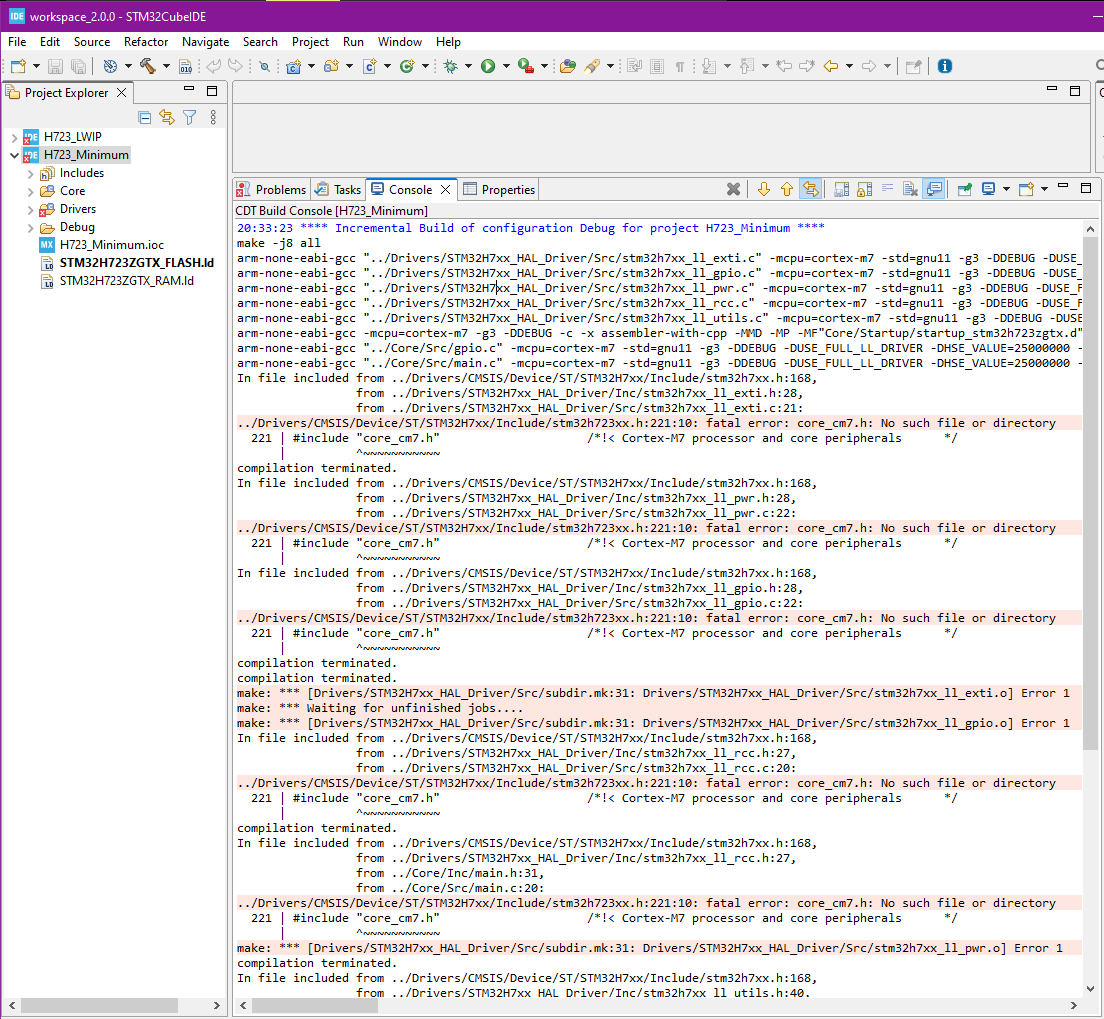
Fehlermeldungen in einer IDE beim Kompilieren
workspace 2.0.0 - STM32CubeIDE Problems Tasks Console Properties H723_LWIP STM32H723_GPIO.ax make -j8 .../Drivers/STM32H7xx_HAL_Driver/Src/stm32h7xx_hal_gpio.c:221 #include "core_cm7.h" No such file or directory compilation terminated. .../Drivers/STM32H7xx_HAL_Driver/Src/stm32h7xx_hal_rcc.c:28 #include "core_cm7.h" No such file or directory compilation terminated.