hello friends,

I'm having problem while doing my testbench coding.
there is no error when check the syntax but my testbench input for clock
and data input show the '0' waveform..it means no pulse..i edit my clock
time but it also not work.
maybe i must do looping for the 'datain' process but i don't know.

i hope u guys will help me to solve this problem.
i'm really appreciate it.thanx..
What toolchain do you use?
For how long did you let the simulation run?
Can you post a screenshot of the simulation waveform?
i use GNU toolchain.
i'm also re-attach the coding that i try to do looping but the result
still the same.
for your information i want the simulation run until 20ms it means 260
cycle.
thanx for your helping.
Attached files:
-
 testbench_pic.jpg
(220 KB)
testbench_pic.jpg
(220 KB)

You are not simulating the testbench. Your top module is obviuosly a
module called "par_encoder". At the blue bar in your screenshot there
should be the "par_encoder_TB"...

> Attached files:
>    NEW_PARENCOD_TB.txt (2 KB, 0 downloads)
Pls attach *.vhd files, not *.txt files.
Then you will see some little magic called "syntax highlighting".
so it means i run with wrong procedure and wrong file?
thanx sir for keep helping me.
Guest
#2743083
Ok. Let's try it with Modelsim:
1 | |
2 | |
3 | |
4 | |
5 | |
6 | |
7 | |
8 | |
9 | |
10 | |
11 | |
12 | |
13 | |
14 | |
15 | |
16 | |
17 | |
Your testbench code didn't compile...
One edit later...
1 | |
2 | |
3 | |
4 | |
5 | |
6 | |
7 | |
8 | |
9 | |
10 | |
11 | |
One more edit...
1 | |
2 | |
3 | |
4 | |
5 | |
6 | |
7 | |
Looks good. Next step: fire up the simulator.
1 | |
2 | |
3 | |
4 | |
See results above.

Duke
Attached files:
-
 par_encoder_simulation.png
(60 KB)
par_encoder_simulation.png
(60 KB)
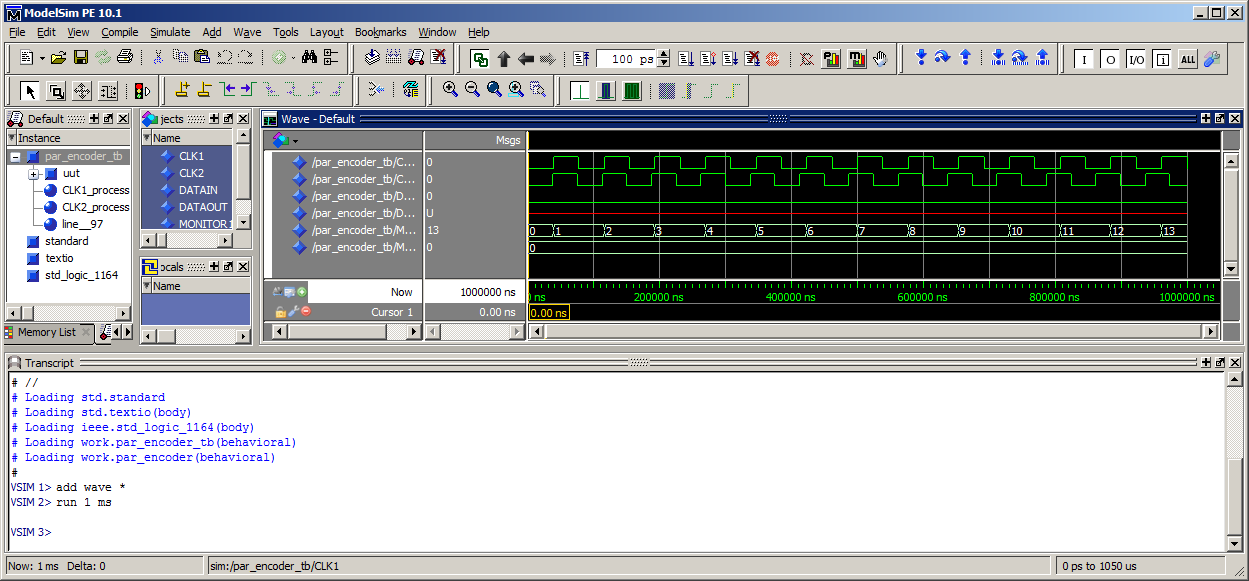
thanx both of you...
now i'm try using the modelsim software..
if have any problem i will share at this site..
thanx a lot..
Guest
#2743278
ISIM should also work without problem, but I'am more familiar with
modelsim...

Duke
Waht are those two clocks in your design?

Are they coming from independent sources (e.g. 10MHz and 25MHz)?
Then you will encounter major problems, because there are various VERY
BIG design flaws in your code:
1 | |
2 | |
3 | |
4 | |
5 | |
6 | |
7 | |
8 | |
9 | |
A two-clock-process, whow!
Where did you get this coding style from?
With some luck you will get it synthesized for real hardware (maybe).
But if so, you will likely encounter significant problem due to passing
values across clock domain barriers without any synchronisation.
Guest
#2789052
In your first wave, you let your simulation run for 1 us but your clock
will have it's first rising edge after 37 us...
So let your simulation run longer (1 ms as did Duke under modelsim).