-
Article
Radar-Verkehrsmessung
LoRaWAN ist hier die LMIC Bibliothek von IBM für Arduino. Von dieser gibt es auch eine Version für den STM32, welche hier zu finden ist. Mithilfe des Videos lässt sich das LoRa-Modul mit dem STM32 verbinden und testen. In unserem Test konnten leider keine Pakete gesendet werden, lediglich die Authentifizierung
Verstärken und Filtern des Radarsignals und das Gehäuse. Mikrocontroller. Als µController wird der STM32F302(R8T6)-NUCLEO-64 verwendet. Ausgewählt wurde dieser, da er eine hohe Taktrate (bis zu 72 MHz) und eine 32-Bit-CPU hat. Dies ist für eine schnelle FFT-Analyse für das Radarmodul von Vorteilen. Auch
-
Article
Cortex M3 OCM3U
und Hauptoszillator wenig Extrabeschaltung RS232 zum programmieren und für Datenübermittlung zum PC STM32F101C8T6, 2.0-3.6V, 5V Tolerante I/Os, max. 36MHz, 32KB Flash, 6KB SRAM, 2x16Bit Timer, 2xSPI, 2xI2C, 3xUART, 10x12Bit ADC, 26xGPIOs, 1xRTC. Größere Modelle im pinkompatiblen Gehäuse erhältlich Software
Batterie:CR 1216) 1 - MAX3232ECWE SO16L - 2 - Pinheader 1x16 - 1x SL 1X36G 2,54 1 - Pinheader 1x2 - ^^ 1 32.768Khz Crystal HC49UP - 1 8Mhz Crystal HC49UP 8,0000-HC49-SMD 1 - Switch - TASTER 9312 1 - STM32F101C8T6 LQFP48 - 1 - SUBD-CON. F09HP D-SUB BU 09US 1 47k Widerstand 0805 SMD-0805 47,0K Work in Process
-
Thread
AVR Transistortester
can optionally set 5v on GPIO, which iirc would be of benefit. I saw other project that use the STM32 to lesser effect and seeing that the Flipper Zero uses the STM32WB55, I was curious if that could be leveraged too. welcoming any input, even if it's confirming this as a foolish idea.
-
Article
Versaloon
Versaloon ist eine open source Plattform fuer den STM32, welche auf einem generischen USB-zu-XXX-Protokoll basiert. Zur Zeit werden mehr als 10 Schnittstellen wie JTAG, SWD, SPI oder I2C unterstützt. Unterstützte Zielarchitekturen. STM8 (SWIM) STM32 (ISP
) AVR8 (ISP/JTAG) LPC900 (ICP) HCS08 (BDM) HCS12(X) (BDM) SVF (JTAG) Unterstützte Hostplattformen. STM8S-Discovery (Onboard-Debugger) STM32VL-Discovery (Onboard-Debugger) siehe auch Forumsbeitrag von Bingo Versaloon Nano Versaloon Mini Versaloon Handy PC-Software. Firmware. Downloads. Siehe auch. Versaloon
-
Thread
ST sensor LIS3LV02DL
it is not worked, so i want to know which MCU you are using? Because i am using the Atmega 32. Liang Meng
same type of modification has to be applied in the read function. I'm using this method with a STM32 and it works fine (I have a SPI clock around 200KHz). Regards, Arnaud.
-
Thread
Weact Blue Pill + GD32F303
and think it would make a nice, low-cost micropython system. The WeAct BluePill+ pcbs have a GD32F303CCT6 (256 kbyte flash, 48 kbyte ram). On the front of the board, remove the GD32F303CCT6 and put a GD32F303CGT6 processors (1024 kbyte flash, 96 kbyte ram) in place. On the back of the WeAct BluePill
differences wrt to the STM32, that mean you cannot just compile micropython for STM32F4 and hope it will work on GD32F303. Gigadevice provides CMSIS and HAL, but what is missing is software that is known to run on this processor
-
Thread
Problems with Yagarto/eclipse/gdb with JFlash Server
Hello, i am trying to connect J-Link with STM32L152D-EVAL board kit as a target device b ut i am getting the error (Error: STM32: connecting to CPU via connect under reset failed). Please give me some solution for this problem. thank you
-
Article
UPlay Basic Interpreter per XMC2Go
gemacht hat, und es nicht sehr viel mehr Aufwand ist, werde ich das ganze wahrscheinlich noch auf eine STM32F4 CPU portieren. Dadurch sollte sich die Zykluszeit noch mal mindestens um den Faktor 5 erhöhen. Anmerkung: Inzwischen habe ich das Ganze auf die STM32F407, STM32F429 und STM32F756 CPUs portiert: 95-uBasic-Library (STM32F407) 28-uBasic-Library (STM32F429) 12-uBasic-Library (STM32F746) Anmerkungen. Wie immer bei "Bastelprojekten" können Fehler in der Hardware und Software nicht ausgeschlossen werden. Ich habe zwar
-
Thread
SPI communication between two microcontrollers
Hello everyone, I am trying to make communication between an STM32F3 microcontroller and a custom board baser on PIC microcontroller using SPI protocol. The STM32F3 acts as a Slave and the custom board as a Master. The clock is set to 10 MHz. I’m using NSS hardware
-
Article
Forth
Forth Fast Forth für MSP430FR5xxx mit SD CARD LOAD, READ and WRITE R8C Anpassung von Gforth EC für R8C STM8 STM8EF eForth für STM8S Discovery Demo C.H.Ting SVFIG Meeting, July 2010 STM8 eForth für die STM8 Familie mit Flash, Multitasking und Erweiterungen, s. Vortrag Forth-eV Tagung 2018 1802, 6809, 8051
und Meta-Compiler der Cross-Compilierung auch für 6502, 8051, AVR, Cortex-M, MSP430, PDP-8, PIC und STM8 unterstützt
-
Thread
Creating blank new C-Project with Yagarto chain for ARM7
tested tool after tool (open source and commercial) to find something to start work with cortexM3 (STM32F10x) immediately. No chance. The reasons: no install package, no documentation, missing scripts for my device, no debug, no linker, no thumb2-compiler, specific debug-tools, expensiv, only 30 days
, and, and. Then I found lots of simple example projects of different users here: http://www.stm32circle.com/projects/index.php I installed Ride7 and within one day my own test board was blinking. Next day I tested debug on the primer2 - OK. Ride supports most ARM7 and cortexM3 from NXP
-
Thread
OpenHR20: Firmware for Honeywell Rondostat HR20E
have Atmega32A
and the communication is working now! I currently implement my own stand-alone master using a STM32 with cortex-m3. I have running a lwIp with udp server and webserver. The plan is to write a android app soon, to replace the webserver interface. But that's future.. Currently I got stuck while
-
Article
WordClock24h
--------------------+ +-------+ Das heißt, dass jeder zweite Streifen "auf dem Kopf" steht. Ab der STM32-Projektversion 1.5.8 werden bis zu 100 weitere LEDs hinter der Buchstabenkette als Ambilight unterstützt. Diese müssen einfach hinter der LED für den letzten Buchstaben in der Kette angeschlossen
seriell. Elektronik. Als Mikrocontroller ist ein STM32F401 oder STM32F411 Nucleo Board vorgesehen. Dieses kostet ca. 12 EUR und mit 512KB Flash und mindestens 96KB RAM genügend Reserven. STM32F4xx Projekt. Die Beschreibung des STM32-Projekts wurde auf
-
Article
STM8
Akkumulatorbasierte, modifizierte Harvard-Architektur mit gemeinsamen Adressraum Busbreite: Datenbus Flash 32 Bit / RAM,EEPROM 8 Bit, Adressbus 24 Bit Hauptspeicher: 512 Bytes bis 6 kBytes SRAM Programmspeicher: 4 bis 128 kBytes Flash EEPROM: 128 Bytes bis 2 kBytes Spannungsversorgung: 1,65 bis 3V (STM8L) bzw
UM0970 User Manual zum STM8L-Discovery Evaluation board STM8L-Discovery (STM8L152C6) Device description, pdf STM8L 151/152 x4/x6 Datasheet C Compiler für STM8S Microcontroller (Freeware) SDCC, ein freier C-Compiler mit STM8-backend
-
Thread
GCC won't allow me to pulse flags
I am developing for a project an STM32 Cortex processor, using gcc on Eclipse. Initially I am working with the ST Electronics STM32F10x-128K-EVAL demo board, which included an LCD display and a joystick. I need to reset the backup domain
-
Thread
Get Binary-Data from Wav-File Locked
follow the links. Some code for "inspiration" may be found in Atmel's Examples for AT91, AVR, AVR32... from atmel.com. IRC I have also seen code to read WAV-Files in at least one of the examples. There is also a "WAV to ADPCM" converter (for PC, with source-code) in the Atmel Application-Notes for
, they acquired this business-section from Sharp). Check Microchip's AppNotes, ST Microelectronics STM32, STR7, STR9 AppNotes...
-
Thread
undefined reference to `memcpy'
For what it's worth, I had the same issue the other day. I was working on an ARM project with the STM32 Cortex-M3 MCU. The quick fix I tried was to use gcc.exe instead of ld.exe for linking. It removed the problem with undefined references, but after debugging the project I discovered that the toolchain
a problem which I have myself spent some hours battling. At the same time, present a solution to a STM32-specific problem with invalid BLX instruction being generated. // MS
-
Thread
Convert YUV(4:2:2) format to BMP file by use of OV9655 image sensor
Hello anyone I working on OV9655 camera module that is connected to stm32f4discover evaluation board. I am able to capture a picture from the OV9655 module where the video output format is based on RGB565 and save as BMP file on SD cart. Now I want to capture a gray scale
sure about that above setting for OV9655 is correct. After the picture is grab by used of DCIM on STM32F407 microcontroller do I want to convert it to BMP file. Right now do I use the same code that is use during conversation of RGB565 to transform YUV(4:2:2) format to BMP file. The code work fine during
-
 Image
Image
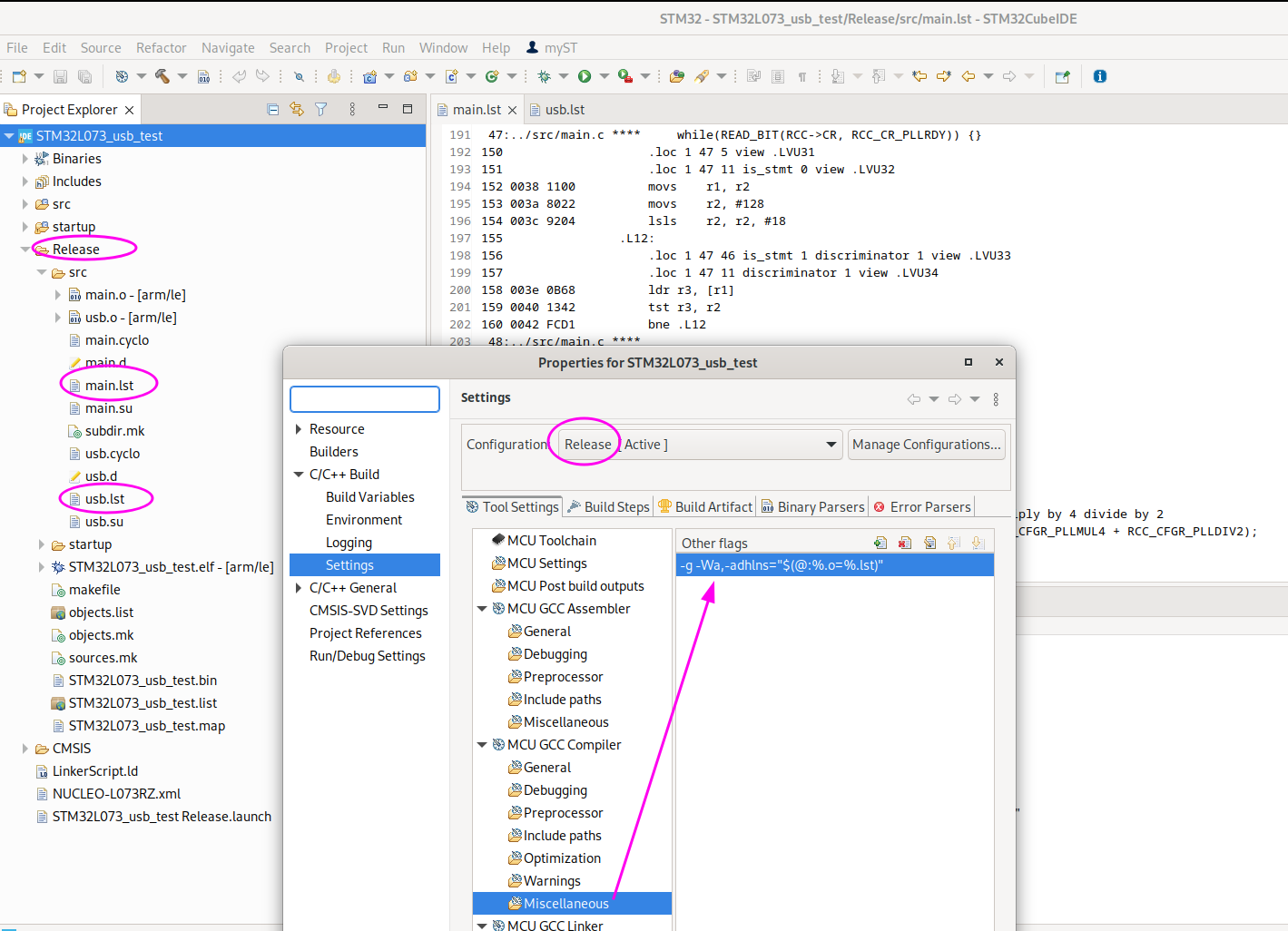
Screenshot einer Software-Entwicklungsumgebung mit Projektstruktur und Einstellungen
STm32-STM32L073_usb_test/Release/src/main.lst-STM32CubeIDE Project Explorer main.lst x usb.lst x main.c while(READ_BIT(RCC->CR, RCC_CR_PLLRDY)) { .loc 1 47 5 view .LVU31 .loc 1 47 11 is_stmt @ view .LVU32
-
Article
Ethernet-Controller
SiLabs CP220x 10 MBit/s, MAC+PHY, Checksum Generator, paralleles Interface CS8900A DM9000E (8 / 16 / 32 Bit Interface) DM9000A/B (8 / 16 Bit Interface) inkl. TCP/IP Checksummenberechnung in HW RTL8019AS (8 Bit Interface) MARVEL 88E1111 Ethernet Phy 10/100/1000 MBit/s W5300 (16/8 Bit Interface, >50MBit/
LM3S8xxx (MAC+PHY) NXP LPC2378, LPC1768 STMicroelectronics STR912 (ARM966E-S® core) STMicroelectronics STM32F107X (Cortex M3 core) STMicroelectronics STM32F2x7X (Cortex M3 core) STMicroelectronics STM32F407X (Cortex M4 core) PIC18F97J60 MAC+PHY PIC32MX795F512H mit Starterkit und sämtlicher Software (TCPIP
-
Thread
Yagarto and floating point
general hint: check if, during the link process, the correct libraries are used. For example: I use the STM32 which got a cortex-m3 core and accedentially linked the libs for a other arm core. resulting in perfekt working code, up to the point on which I tried to use floatingpoint. that is, because the STM32 got no fpu and than the wrong lib was linked and used unsupported commands to emulate the fpu. You should check the main.map file, it includes the linked libs. then check if they are supported/
-
Thread
Ebike Lishui controller, custom FW, problem at certain voltages
Hi fellows, I have a strange problem with ebike controller using STM32 uC (Device family :STM32F10xx Low-density) I have a fischer 1606 ebike with a Lishui controller which did not have original display. I found that this controller has alternative firmware made by
-
Thread
startup_lpc17xx.s GNU
for you: http://www.siwawi.arubi.uni-kl.de/avr_projects/arm_projects/arm_memcards/index.html#chanfat_stm32 It's for another controller also with Cortex-M3 core and it should be rather easy to port the linker-script and startup-code to LPC17xx. Decide yourself if it's "simple" enough Maybe someone else
program the target, is possible enable this function ? - The debugger function remain limited to 32K ? or is possible to debug code long more then 32k ? Thanks in advance
-
Thread
Encoder Timer switches between 0 and highest value.
problem could be. You probably need more information, im happy to give them to you. I work with a STM32H745XIHx. Thank you
u8iEncoder) { if(u8iEncoder == 1) { HAL_TIM_Encoder_Start(&htim3,TIM_CHANNEL_1); } } uint32_t getEncoder(uint8_t u8iEncoder) { uint32_t ui32Counter = 0; if(u8iEncoder == 1) { ui32Counter = __HAL_TIM_GET_COUNTER(&htim3); } return ui32Counter; } /* USER CODE END 0 */ TIM_HandleTypeDef
-
Thread
How to stop breaking at reset
I am developing a number of projects for STM32 processors using Eclipse, gcc, gdb and an Olimex ARM-USB-OCD jTag dongle. All works well, but every time I relaunch the project in debug mode the code stops at address 0x08000000. The debug window
this always happens. Furthermore I suspect it is using up one of the 6 breakpoints provided by the STM32, which restricts debugging. I launch gdb with the following commands: target remote localhost:3333 monitor reset init load monitor reset init break main The first breakpoint it should
-
Thread
Layered OS: DMA Transfer into Filesystem
, of which one is to learn PS: even though this question is more a theoretical one, I use C on an STM32 --- German: Hallo, ich programmiere ein Betriebssystem* für mein aktuelles Projekt und hab jetzt ein kleines Problem. Das OS ist "layered", also mit Schichten aufgebaut. Es gibt ein HAL
lernen möchte. PS: Auch wenn das eher eine theoretische Frage ist: Ich programmiere in C für einen STM32
-
Article
Bootloader
C, RS232, unterstützt zwei UARTs gleichzeitig, mit Android Upload App. (Homepage) TinySafeBoot avr32webboot - AVR32 Bootloader mit Webinterface ARM. libopencm3 is a free/libre/open-source firmware library for various ARM Cortex-M3 microcontrollers, including ST STM32, Toshiba TX03, Atmel SAM3U, NXP
für ARM LPC2294 von Ulrich Radig (MMC, uCLinux, LPC2000). "USB Firmware Upgrader" für NXP LPC214x stm32bootloader for stm32 with USB IAP. sam7dfu USB DFU implementation for at91sam7 openBLTfür STM32. (Freier open source bootloader. Habe den DEMO für ATOLLIC adaptiert und werde es bald hier bereit stellen
-
Thread
Filesystem for NOR flash
implementation: https://github.com/ivanovp/pifs There is an emulator for PC and few demos for STM32 MCUs: Nucleo-F413ZH, Maple Mini, STM32F4_VE (cheap Chinese dev.board). It supports directories, dynamic/static wear leveling. Best regards, Peter
-
Thread
Microcontroller for game controller
Max Frank wrote in post #4416349: > Atmega32U4 supports native USB These are much cheaper and much faster and HID demo is included: http://www.silabs.com/products/mcu/8-bit/efm8-universal-bee/Pages/efm8-universal-bee.aspx Even these ARM
I have seen "simple" controllers with Chinese 8051 e.g. STC and complex ones usually ARM e.g. STM32: https://de.ifixit.com/Teardown/PlayStation+Move+Controller+Teardown/3596
-
Article
JTAG
und die Pins sind perfekt angeordnet für jede Art der Anwendung. In diesem Beispiel ist der UART 1 (STM32) benutzt mit den Pins PA9/PA10. Wenn die Boot-Pins auf einen separaten Jumper-Block gelegt werden, so könnte auch mit der ST Software ein Flash Update durchgeführt werden. Hier die Erklärung warum
10 kinds of interfaces including ISP, JTAG, SWD, SPI, IIC and so on. Programming is supported for: STM8 support(SWIM) STM32 support(ISP/JTAG/SWD) siehe auch Forumbeitrag von Bingo * LPC1000 support(ISP/JTAG/SWD) LM3S support(JTAG/SWD) AT91SAM3 support(JTAG/SWD) AT89S5X support(ISP) PSOC1 support(ISSP
-
Thread
Problems with Helix MP3 Decoder
for "xmp3_UnpackFrameHeader" [referenced from C:\IAR Systems\Embedded Workbench 5.4\arm\examples\ST\STM32F10x\ IAR-STM32F103ZE-SK\ARMP3\Flash Debug\Obj\mp3dec.o] Can someone give me help and tell me where can be the problem? Thank's everybody. Excuse me for my english, it's very bad.
-
Article
SportTracker
dafür selbstgemacht ;-)). Darüber hinaus ist das Projekt eine Spielwiese um verschiedene Dinge mit dem STM32 Controller auszuprobieren: Erste Erfahrungen mit einem RTOS (in meinem Fall µC/OS II) Speichern von Daten auf SD-Karte mit FAT Dateisystem Ansteuerung von TFT-Displays Auswertung von GPS-Daten Batteriebetrieb
GPX-Datei Entprellen von Tasten Hardware. Im Moment läuft alles noch auf einem Keil Starterkit mit STM32F103ZE Controller. D.h. ein Schaltplan mit Layout ist noch nicht erstellt. Controller Pinning. Der Controller des SportTrackers ist aktuell wie folgt beschaltet: Pin Nr. Pin Port Config Funktion 70