-
Thread
mapping the exact input to the output
#include "stm32f0xx.h" #include "stm32f0308_Discovery.h" #define in0 GPIO_Pin_0 #define in1 GPIO_Pin_1 #define in2 GPIO_Pin_2 #define in3 GPIO_Pin_3 #define in4 GPIO_Pin_4 #define in5 GPIO_Pin_5 #define
out5 GPIO_Pin_5 #define out_GPIO GPIOC void TM_Delay_Init(void); void TM_DelayMillis(uint32_t millis); void TM_DelayMillis1(uint32_t millis); void TM_DelayMillis2(uint32_t millis); GPIO_InitTypeDef GPIO_InitStructure ; uint32_t multiplier; int main(void) { SystemInit
-
Article
NIC
Ende auf der Console ausgegeben. Bei einem mit 168MHz getakteten STM32F407VE dauert das Programm knapp 3000msec. Das entspricht etwas mehr als 333.000 Schleifendurchläufen pro Sekunde. Bei einem mit 100MHz getakteten STM32F411RE sind dies ca. 3900msec bzw. 256.000 Schleifendurchläufe pro Sekunde. Bei einem mit 85MHz getakteten STM32F401RE sind es noch knapp 200.000 Schleifendurchläufe, beim STM32F103 mit 72MHz-Takt ca. 180.000 Durchläufe. Das Programm kann aber noch stärker vereinfacht werden. Jetzt verzichten wir auf die Variable
-
Article
MINOS
Operating System MINOS ist eine sehr einfache, trotzdem aber auch komfortable Firmware, welche auf einem STM32F4xx läuft - vorzugsweise dem STM32F407VET6 Black Board, welches für einen einstelligen Euro-Betrag zu haben ist. = MINOS = MINOS unterstützt dabei ein Dateisystem auf einer eingesetzten SD-Karte und
STM32 also ein Wert von 0 bis 15. Der Rückgabewert ist entweder LOW oder HIGH. Beispiel: ---- UART. Auf dem STM32F407VET6 BlackBoard können UART2-UART6 als freie Schnittstellen verwendet werden. uart.init
-
Article
MCURSES
verwendete Baudrate angepasst werden: #define MCURSES_BAUD 19200L // UART baudrate, use 115200 on STM32Fxx Für STM32-Mikrocontroller kann zusätzlich noch die UART-Nummer eingestellt werden, nämlich 1-6 auf STM32F4xx, 1-3 auf STM32F10x. Der Wert wird für andere Mikrocontroller - wie z.B. ATmega - ignoriert
inkl. Funktionstasten, Cursor-Tasten etc. Versions-Historie. 13.03.2015: Version 2.2.0 Portierung auf STM32F10x und STM32F4xx Auswahl der UART-Schnittstelle (nur STM32) Neue Funktionen: printw() und vprintw() (nur STM32) Neue Makros: mvprintw() und mvvprintw() (nur STM32) Variablen-Typen uint8_t auf uint_fast8
-
Thread
GNU issues for cpp
GCC issue 1: We are working on the STM32F0 series, where the src code is in C++ and the compiler used is the GCC ARM (version 4.4.1) which compiles fine. However when we changed the GCC compiler to 4.7.3 we are observing linker issues as
Cortex M0 and wrking on STM32F051.
-
Thread
CooCox Tools
release CoIARPlugin V1.2.1, supported new adapters: NGX, PicoJTAG and KT-Link, supported new chips: ST: STM32F100series, STM32F101series, STM32F105series, Energy Micros: EFM32G2xx series, NXP: LPC1200series. For detail information, you can visit http://www.coocox.org
-
Article
MP32F103-Stick: Ein Mini-Mikrocontroller-Board mit USB und bis zu 4MB Datenspeicher
nach Einarbeitung in diese Materie veröffentliche ich hier ein kleines Board mit dem Mikrocontroller STM32F103CBT6 von STMicroelectronics (www.st.com). Dieser Chip hat 128KB Flash, 20KB RAM, SPI, I2C, USART, USB, CAN, ADC und läuft bis 72 MHz. Das Board wird genauso aufgebaut sein wie mein MP2103-Stick
gängigen Betriebssysteme vom Hersteller FTDI-Chip angeboten werden. Funktionsmodell. LINK: Datasheet vom STM32F103CBT6 LINK: st.com-Page vom STM32F103CBT6 LINK: Datasheet und Anwendung vom AT45DBxxx LINK: Datasheet vom TPS62203 Schaltplan. Herzstück des Boards ist der Mikrocontroller STM32F103CBT6 (IC1) mit
-
Article
IRSND
lauffähig. AVR ATtiny87, ATtiny167 ATtiny45, ATtiny85 ATtiny44, ATtiny84 ATmega8, ATmega16, ATmega32 ATmega162 ATmega164, ATmega324, ATmega644, ATmega644P, ATmega1284 ATmega88, ATmega88P, ATmega168, ATmega168P, ATmega328P XMega ATXmega128 PIC (C18-Compiler) PIC12F1840 PIC18F4520 STM32 STM32F4xx STM32F10x
18.06.2012: Unterstützung für ATtiny87/167 hinzugefügt 05.06.2012: Korrekturen Portierung auf ARM STM32 - nun getestet 23.05.2012: Portierung auf ARM STM32 (ungetestet!) 23.05.2012: Bugfix Timing für 2. Frame beim Denon-Protokoll 27.02.2012: Neues Protokoll: IR60 (SDA2008) 27.02.2012: Bug beim Senden
-
Thread
exception handling code in binary from pure C code
Hi, I tried out yagarto to generate code for a cortex-M3 (STM32). I got it working, but I was surprised a whole bunch of exception handling code ends up in my binary (the source code is pure C) This happens both with my (complex) program, and the STM3210ETest small example project (yagarto howto page, STM32), if I add this small function: [c] unsigned long long xyz(unsigned long a, unsigned long long b ) { return a/b; } [/c] If i check the library, there are some .ARM.extab/.ARM.exidx
-
Thread
Which microcontroller to use and how?
microcontrollers are primarily programmed in C. AVR microcontrollers (e.g. ATmega328P or ATmega32U4) are easy to learn and there are lots of informations online. If you want something larger then I would recommend any ARM based microcontroller, for example the STM32F103 series which is available
recommend to control the MAX5217 for the best results and more accurate? price is not important. the STM32F103 ?
-
Thread
Embeetle IDE free for all users, now supports Blue Pill and more.
and developed a visual debugger. Just recently, Embeetle IDE integrated the Blue Pill board. The STM32 Blue Pill is a 32-bit Arduino-compatible development board that features the STM32F103C8T6. A member of the STM32 family of ARM Cortex-M3 core microcontrollers. The STM32 Blue Pill board has nearly
Embeetle. https://www.kickstarter.com/projects/embeetle/embeetle-ide-integrating-wch-microcontroller-ch32v203 https://www.kickstarter.com/projects/embeetle/embeetle-ide-integrating-wch-microcontroller-ch32v003 As the Embeetle team grows, more and more MCU will be supported and we would love your precious
-
Article
IRSND - english
MCU families: AVR ATtiny87, ATtiny167 ATtiny45, ATtiny85 ATtiny44, ATtiny84 ATmega8, ATmega16, ATmega32 ATmega162 ATmega164, ATmega324, ATmega644, ATmega644P, ATmega1284 ATmega88, ATmega88P, ATmega168, ATmega168P, ATmega328P XMega ATXmega128 PIC (C18 Compiler) PIC12F1840 PIC18F4520 STM32 STM32F4xx STM32F10x
corrections, adaptions to Arduino 2012-06-18: Added support ATtiny87/167 2012-06-05: Corrected port to ARM STM32 - now tested 2012-05-23: Port to ARM STM32 (untested!) 2012-05-23: Bugfix timing for 2nd frame of Denon protocol 2012-02-27: New protocol: IR60 (SDA2008) 2012-02-27: Bugfix sending Biphase frames
-
Article
IRMP
(getestet auf STM32F401RE/F411RE Nucleo, STM32F4 Discovery) STM32F10x (getestet auf STM32F103C8T6 Mini Development Board) STM32 mit HAL-Library (NEU!) STM8 STM8S103F3 TI Stellaris LM4F120 Launchpad (ARM Cortex M4) ESP8266
keyboard converter. IRMP2Keyboard infrared remote to PS2/USB keyboard converter IRMP + IRSND Library für STM32F4. IRMP für STM32F4 IRSND für STM32F4 IRMP auf STM32 - Bauanleitung. Studienarbeit - Erweiterung der Arduino Plattform. Forumsbeiträge. Forumsbeitrag: IRMP und IRSND als Protokoll für 433 MHz Sender
-
Thread
Library LibOpenCM3
Hello everyone, Is LibOpenCM3 (Open-Source lowlevel hardware library ) a good choice for a STM32F303 project ? Regards Pier Tilma The Netherlands
General purpose IO (leds, pusbutton) So my conclusion : Yes, LibOpenCM3 is a good choice for a STM32F303 project. Regards Pier Tilma The Netherlands
-
Article
Benutzer:Mtothea
// Mein erstes Mainfile // Mit der conf-Datei beherrschen und steuern wir // die gesammte include "stm32f4xx_conf.h" include "stm32f4xx.h" void RCC_init(void){ // ueber die RCC werden die diversen Peripherie-Einheiten eingeschaltet // (durch konfiguration der RCC) RCC_AHB1PeriphClockCmd(RCC_AHB1Periph_GPIOD
Nasebohren } } Systick. //Mit der CONF-Datei beherrschen und steuern wir //die ganze FW-Lib include "stm32f4xx_conf.h" //die Includes, damit wir und nichtmehr //irgedwelche Adressen zusammensuchen muessen include "stm32f4xx.h" void RCC_initialisieren(void){ //ueber die RCC werden die diversen Peripherie-Einheiten
-
Article
IRMP - english
(tested on STM32F401RE/F411RE Nucleo, STM32F4 Discovery) STM32F10x (tested on STM32F103C8T6 Mini Development Board) STM32 with HAL library (NEW!) STM8 STM8S103F3 TI Stellaris LM4F120 Launchpad (ARM Cortex M4) ESP8266
control: A MythTV Remote Control without LIRC. PC Remote Control with ATtiny85 IRMP + IRSND Library for STM32F4. IRMP for STM32F4 IRSND for STM32F4 IRMP on STM32 - Construction Guidance. Seminar Paper - Extension of Arduino Platform. www.eislab.fim.uni-passau.de/files/publications/2010/StudentDiener_ErweiterungDerArduinoPlattform.pdf
-
Article
Mikrocontroller Vergleich
8051: Keil MCBx51 (z. B. für ~240 von mouser.com) ARM: allgemein: (z.T. hier im Shop erhältlich), STM32 STM32 Discovery Board für ca. 20 Euro NXP Entwicklungskit LPCXpresso-Entwicklungskits (PDF) für ca. 25 Euro Infineon XMC4500 Relax Kit für ca. 10 Euro EFM32 Energy Micro Starter Kit ab ca. 55 Euro
Spannungserzeugung, manchmal 2 Betriebsspannungen benötigt; Tendenz aber fallend. Links. Forum 8051 ARM AVR EFM32 LPC1xxx MSP430 PIC R8C ST7 STM8 STM32 Z8 Z8_encore! Vergleich (Original in englisch von Jay Carlson) Vergleich (in deutsch übersetzt)
-
Article
Benutzer Diskussion:Erlkoenig
Du hast meinen Beitrag Linux auf STM32 ausgelagert. Wie soll jetzt jemand ohne suchen diesem Beitrag finden ? Er sollte über die Menüstruktur links mit 2-3 Klicks erreichbar sein. Indem man im STM32-Artikel nach "ucLinux" sucht, oder über die Suche auf der Startseite nach "Linux STM32", oder indem man den dritten Link bei Tutorials für diverse Tool-Kombinationen anklickt. Selbst bei Google ist das erste Ergebnis der Suche nach "Linux auf STM32" genau der Artikel. Du könntest die
-
 Image
Image
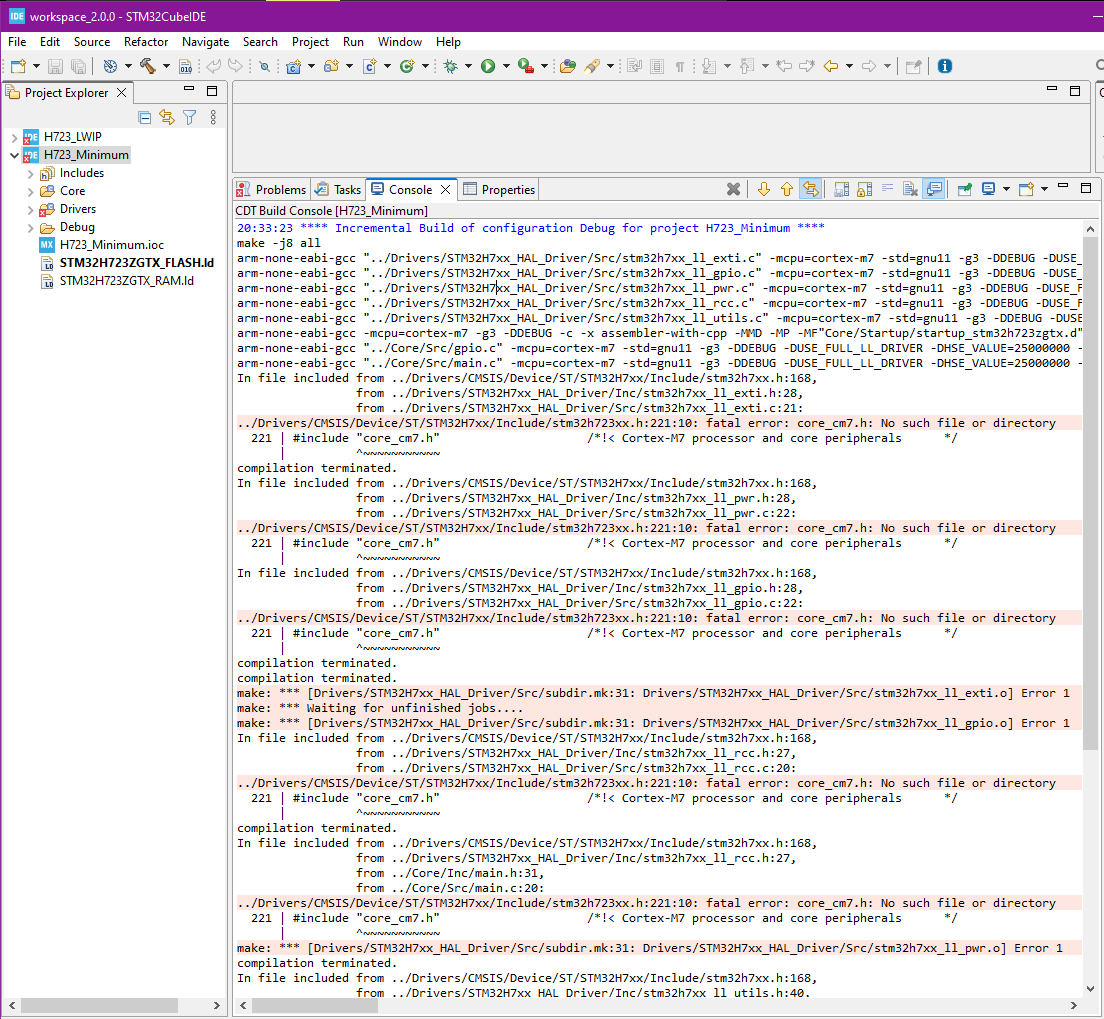
Fehlermeldungen in einer IDE beim Kompilieren
workspace 2.0.0 - STM32CubeIDE Problems Tasks Console Properties H723_LWIP STM32H723_GPIO.ax make -j8 .../Drivers/STM32H7xx_HAL_Driver/Src/stm32h7xx_hal_gpio.c:221 #include "core_cm7.h" No such file or directory compilation terminated. .../Drivers/STM32H7xx_HAL_Driver/Src/stm32h7xx_hal_rcc.c:28 #include "core_cm7.h" No such file or directory compilation terminated.
-
Thread
SD card lock and unlock
check out whether your SD card support lock/unlock. I have three SD cards tested, two from panasonic(32MB) and one from kingston(2GB),it seems the old panasonic card does not support this function, and the new kongston SD works well. You can use a mobile phone to check it. I don't know why Windows doesn't
SD card support, you would see a "password protection". I use the MOTO E6 to lock my card, and use STM32F103VBT6 to unlock, then use STM32 to lock and E6 to unlock, both works well. I use the SPI mode. If I cound help you, please email chairang<at>126.com
-
Article
Benutzer:Claus mueller
und privat beschäftige ich mich zur Zeit intensiv mit der Cortex-M0 (bzw. M0+) Reihe von STMicro (STM32F030 und STM32L051), ansonsten aber auch mit Cortex-M3 und ziemlich viel mit -M4. Über die Jahre hatte ich alle möglichen (PICs, 8051 von etlichen Herstellern, MSP430 und natürlich auch AVR) und unmöglichen
das Laden des Navigationgerätes verwendet. Als Steuerung dient ein µCortex-Modul bestückt mit einem STM32F030. Die Schaltung besteht im Grunde aus einem bipolaren Relais mit der zugehörigen externen Beschaltung, etwas Filterung, ein paar Mosfets und Schraubklemmen.
-
Thread
"undefined reference to memcpy" error - please help!
hello dear forum , I am trying to compile a C program for STM32F407 microcontroller with OlimexODS ( Eclipse + yagarto compiler ) I get the error; "undefined reference to memcpy" error as you can see in the attached picture ---------------------- makefile
. > will it link with latest version of library ? I don't know your library. And Idon't know STM or ARM. It's just the general scheme how gcc works. If GCC and Binutils and the libraries are configured and built correctly, it will work.
-
Thread
confused by various UDP checksum algorithms
hello forum, I am trying to send an UDP packet (contains only "TEST" string) from STM32 to VB6 winsock I can see packets going with wireshark software however winsock data_arrival subroutine never gets called ( if I send from laptop winsock to PC winsock or vice versa UDP packet
printscreen winsock cannot receive this packet I have an USRobotics adsl router between PC and STM32F4
-
Thread
Networking Eclipse projects
'Include' containing .c and .h files respectively. There is an additional file in 'Include' named stm32rom.ld which contains the processor characteristics needed by the linker. There is a third folder named 'obj' for the compiler and linker output files. The makefile on Server invokes the compiler
/stm32rom.ld: No such file or directory". I can't understand this, since the -T command format is exactly the same as the -I and compiler command formats, which are executed correctly. The makefile
-
Article
LPC1xxx für Umsteiger
Umsteigen lohnt sich auf jeden Fall, egal auf welche Prozessorfamilie. In diesem Artikel wird die 32-Bit Familie LPC1xxx von LPC kurz betrachtet. Die 32-Bit Controller der STM32-Familie werden in den Betrag STM32_für_Einsteiger und STM32 sehr schön vorgestellt, und sehr rudimentär mit dem LPC1xxx verglichen
Installationsanleitung zur IDE LPC1xxx Codebase LPDXpresso Download (Kostenlos mit Debugger) LPCXpresso Homepage STM32 für Einsteiger
-
Thread
problem using adapter Olimex tiny-h with OpenOCD v0.4
Hi, I'm trying to get a fresh ARM-USB-Tiny-H adapter to program and debug my STM32-P103 board via OpenOCD v0.4 under Ubuntu 10.04. The configuration works fine with my older ARM-USB-OCD but with the Tiny-H, I always get this error: "Error: unable to set latency timer: 17"
10.04 on Asus Eee PC (1Gig RAM, BNL Single Core) Interface: Olimex ARM-USB-TINY-H Target: Olimex STM32-P103 Evalboard Any clue what I might be missing? Gregor -- If its not playing with Tux, it's worth nothing.
-
Article
Entscheidung Mikrocontroller
adaptiert werden. Diese PCB arbeitet hervorragend mit der kostenlosen Entwicklungssoftware zusammen. STM32. System Preis STM32F4DISCOVERY Demoboard incl. USB-JTAG/SWD Programmer & Debugger ~ 9..20€ Eine Umfangreiche Übersicht über die Funktionalitäten der STM32 µC sind im Artikel STM32 beschrieben. Viele Links zu Demo-Boards, Compiler, IDE's, Debugger sind im Artikel gesammelt. Ein µC Vergleich mit STM32 und andere sind im Artikel STM32 für Einsteiger gut zusammen gelistet. Programmübertragung. Im Idealfall stellt sich die Frage, wie das Programm in den Mikrocontroller kommt, für den Programm-Entwickler
-
Thread
How do you program arm processors? Locked
programmable with 'FlashMagic'. Use google, FlashMagic is free downloadable and usable. - The STM32Fxxx, programmable with: my own 'STM32Prog', downloadable on www.mikrocontroller.net, subforum 'projekte&code', also with old 'erfos' programmer, also with a piece of software from ST somewhat like
-
Thread
va_args, printf and DMA memory problems
past few days as I try to understand why and what is going on... So here it goes: Current config: stm32f407VG (same as stm32f4 discovery) I set up a project using the default linker and startup files from www.onarm.com. Init the ADC & DMA's [code] ADC_CommonInitStructure.ADC_Mode
DMA_InitStructure.DMA_Channel = DMA_Channel_0; DMA_InitStructure.DMA_Memory0BaseAddr = (uint32_t) &RawADCData.adcRaw1; DMA_InitStructure.DMA_PeripheralBaseAddr = (uint32_t) ADC_CCR_ADDRESS; DMA_InitStructure.DMA_DIR = DMA_DIR_PeripheralToMemory; DMA_InitStructure.DMA_BufferSize
-
Thread
i want to map in0 to out0
#include "stm32f0xx.h" #include "stm32f0308_Discovery.h" #define in0 GPIO_Pin_0 #define in1 GPIO_Pin_1 #define in2 GPIO_Pin_2 #define in3 GPIO_Pin_3 #define in4 GPIO_Pin_4 #define in5 GPIO_Pin_5 #define
define out5 GPIO_Pin_5 #define out_GPIO GPIOC void TM_Delay_Init(void); void TM_DelayMillis(uint32_t millis); void TM_DelayMillis1(uint32_t millis); void TM_DelayMillis2(uint32_t millis); GPIO_InitTypeDef GPIO_InitStructure ; uint32_t multiplier; int main(void) { SystemInit
-
Article
USB
6 PWM 2 USART, 2 CAN SPI, I2C, SSC SD/MMC, Ethernet 10 Mbit, Businterface, JTAG Digikey ca. 8 € ST STM32F10x Full 36..144 3,3V/5V Cortex-M3 72MHz 512KB 64KB 21 x 12bit 2 x 12bit, 32 PWM 5 USART, 1 CAN SPI, I2C, SSC Siehe Artikel STM32 Farnell ab ca. 5 € ST STM32F4xx Full + Hi 64..176 3,3V/5V Cortex-M4
8+2KB 8 x 12bit PWM 2 USART SPI, I2C verschiedene Ausbaustufen TI zurzeit als Muster ST STM32F10x Full 36..144 3,3V/5V Cortex-M3 72MHz 512KB 64KB 21 x 12bit 2 x 12bit, 32 PWM 5 USART, 1 CAN SPI, I2C, SSC Siehe Artikel STM32 Farnell ab ca. 5 € Silicon Laboratories C8051T3xx, -T6xx, -F3xx, -
-
Thread
Changing return address of exception
I am using olimex stm32 board. It has cortex-m3 processor. For my project, I require to change return address when processor is executing exception. I know that it is stored in stack, But where in stack? It is always
solved. I am writing the code to change return address which worked for me. This code is for olimex stm32f107 board. asm( "TST LR, #4;" "ITE EQ;" "MRSEQ R0, MSP;" "MRSNE R0, PSP;" ); asm("mov %0, r0" : "=r"(lraddr)); nxaddr=lraddr[12]; lraddr[12]=NEW
-
Thread
embedding C source in the disassembler window
Anglia Electronics kindly sent me an Eclipse version of the STM32demo project. It includes a custom makefile, so it doesn't use any outside resource such as Solaris to create the makefile. I am trying to create my own project to emulate this with good success
system, because it now fails at the end of compilation with the message 'cannot open map file obj\stm32demo.map' I am now getting extremely frustrated with Eclipse. I want to use it as a tool for developing a project to run on embedded hardware, but I am spending more time trying to fix the tool
-
Article
Benutzer:Mampf
alten aufarbeiten, in eine sinnvolle Form bringen und dann unter Projekt und Code veröffentlichen. STM32F429 DIY-Board. STM32F429 @ 168MHz 32MB SDRAM I2S Audio-DAC IR (derzeit unbenutzt) WLAN (ESP8266) µSD 2 USB (CDC, zweites Interface nicht benutzt) Software: Helix MP3-Decoder 7 Band (IIR) Equalizer
vollständig hinter der Röhre :) keine VFD-Spezialbauteile :) Kurzes Video: Mini-Word-Clock. Benutzt einen STM32F103 Hier noch ein kurzes Video zu V2.0: RGB Moodlight/Clock/Reminder. Spaßeshalber hatte ich mir überlegt, ein RGB Mood-Light zu bauen, da ich dafür einige verschiedene Verwendungszwecke habe. Außer
-
Article
ARM-ASM-Tutorial
development boards with these controllers are available, for example: Nucleo-F103, “Blue Pill” (search for “stm32f103c8t6” on AliExpress, Ebay or Amazon), Olimexino-STM32, STM32-P103, STM32-H103, STM3210E-EVAL. Processor type & documentation. First, the microcontroller manufacturer’s documentation is used to
customary to name the linker script after the controller they are intended for, so create a text file “stm32f103rb.ld” or “stm32f103c8.ld” with the following contents: Example name: “LinkerScriptSimple” This is this minimum viable linker script for a microcontroller. If you are using a STM32F103C8, replace
-
Article
Linksammlung
, ranging from 8 bits to 32 bits CPUs and even PCs. ChibiOS/RT Circle-OS for STM32 Kostenloses OS, sehr klein mit Basisfunktionen fuer STM32 CoOS eCos - "Real-Time-Operating-System" o.a. auch für ARM7 FreeRTOS (.org!) - "Real-Time-Kernel
Header-Boards (LPC2000, STR7, AT91SAM, ADI, TI, OKI u.a.) Propox Primer2 from Raisonance Focus auf STM32 mit sehr grossem Forum im STM32circle Revely Evaluations- und Demo-Boards mit Sharp ARM Controllern. Teilweise mit SVGA-Anschluss. SKPang electronics Entwicklungsboards für diverse ARM7/9 (UK) SSV