-
Article
MINOS
Operating System MINOS ist eine sehr einfache, trotzdem aber auch komfortable Firmware, welche auf einem STM32F4xx läuft - vorzugsweise dem STM32F407VET6 Black Board, welches für einen einstelligen Euro-Betrag zu haben ist. = MINOS = MINOS unterstützt dabei ein Dateisystem auf einer eingesetzten SD-Karte und
, beim STM32 also ein Wert von 0 bis 15. Beispiel: gpio.get. Liest den Zustand des ausgewählten Pins. Syntax: Als PORT kann GPIOA, GPIOB, GPIOC usw. gewählt werden. BIT ist das jeweilige Bit am I/O-Port, beim STM32
-
Thread
STM32H7 bank swap break at address 0x81006fe
with the ST32 H743ZI2. I wasted much of time to fix it but i didnt get it. Maybe because im new in STM32 controllers. I copied the bank swap code from STM32CubeH7 Firmware Examples and did a few modifications regarding to gpio configuration in CubeMX. I did them because i want to implicate the code in a excisting project without the stm32h7xx_nucleo headers. Following the Code for Bank1: [c] HAL_FLASH_Unlock(); HAL_FLASH_OB_Unlock(); while (1) { /* Wait for BUTTON_USER is released */ if (HAL_GPIO_ReadPin(GPIOC
-
Article
IRMP auf STM32 – stark vereinfachte Bauanleitung
auch per Fernbedienung mit dem Konfigurationsprogramm eingeben. Testen (Linux/Windows). Windows: Aus stm32IRconfig_gui.exe holen, Empfänger anschliessen, stm32IRconfig_gui starten, "receive mode" drücken und testen oder aus stm32IRconfig.exe holen, ST-Link anschliessen, stm32IRconfig starten, m eingeben
as well via remote control with the configuration program. Testing (Linux/Windows). Windows: Get stm32IRconfig_gui.exe from , connect the receiver, start stm32IRconfig_gui, press "receive mode" and test or get stm32IRconfig.exe from , connect the receiver, start stm32IRconfig, enter m for monitor mode
-
Article
STM32 Eclipse Installation
OpenOCD und LD Linker-Datei src: die eigenen Quellcodes makefile Das Projekt wurde geschrieben für den STM32F103RC (256K Flash/48K RAM), läuft aber auch mit einem STM32F103xB da der Stack-Pointer auf 20K initialisiert wird. Details stehen in der Datei "src/stm32f10x_vector.c", Zeile 29,30: Damit wird der
Dennoch hilft es die Peripherie einfacher planen zu können. Weblinks, Foren, Communities. Artikel STM32 Artikel STM32 CooCox Installation Thread zu diesem Thema
-
Thread
Library LibOpenCM3
Hello everyone, Is LibOpenCM3 (Open-Source lowlevel hardware library ) a good choice for a STM32F303 project ? Regards Pier Tilma The Netherlands
General purpose IO (leds, pusbutton) So my conclusion : Yes, LibOpenCM3 is a good choice for a STM32F303 project. Regards Pier Tilma The Netherlands
-
Thread
CMSIS-RTX with GCC on STM32F4 Discovery
searching, this maybe the first project that provides a reference for CMSIS-RTX with GCC working on an STM32 device. Cheers!
Hello Rajiv Verma, I appreciate your hard work. Great. When I tried it in my STM32F407G-DISC1 board, I found that the tempo was little bit slow. Apart from that, all are okay. Cheers
-
Article
IRSND
ATmega88P, ATmega168, ATmega168P, ATmega328P XMega ATXmega128 PIC (C18-Compiler) PIC12F1840 PIC18F4520 STM32 STM32F4xx STM32F10x STM32 mit HAL-Library (NEU!) TEENSY 3.0 MK20DX256VLH7 (ARM Cortex-M4 72MHz) Unterstützte Protokolle. IRSND unterstützt die folgenden Protokolle: A1TVBOX ACP24 (NEU!) APPLE BANG_OLUFSON
18.06.2012: Unterstützung für ATtiny87/167 hinzugefügt 05.06.2012: Korrekturen Portierung auf ARM STM32 - nun getestet 23.05.2012: Portierung auf ARM STM32 (ungetestet!) 23.05.2012: Bugfix Timing für 2. Frame beim Denon-Protokoll 27.02.2012: Neues Protokoll: IR60 (SDA2008) 27.02.2012: Bug beim Senden
-
Thread
CooCox Tools
release CoIARPlugin V1.2.1, supported new adapters: NGX, PicoJTAG and KT-Link, supported new chips: ST: STM32F100series, STM32F101series, STM32F105series, Energy Micros: EFM32G2xx series, NXP: LPC1200series. For detail information, you can visit http://www.coocox.org
-
Article
Benutzer:Mtothea
/ Mein erstes Mainfile // Mit der conf-Datei beherrschen und steuern wir // die gesammte include "stm32f4xx_conf.h" include "stm32f4xx.h" void RCC_init(void){ // ueber die RCC werden die diversen Peripherie-Einheiten eingeschaltet // (durch konfiguration der RCC) RCC_AHB1PeriphClockCmd(RCC_AHB1Periph_GPIOD
/ Mein erstes Mainfile // Mit der conf-Datei beherrschen und steuern wir // die gesammte include "stm32f4xx_conf.h" include "stm32f4xx.h" void RCC_init(void){ // ueber die RCC werden die diversen Peripherie-Einheiten eingeschaltet // (durch konfiguration der RCC) RCC_AHB1PeriphClockCmd(RCC_AHB1Periph_GPIOD
-
Thread
yagarto example project for STM32F100C4 chip
Hello, I'm new user of the yagarto tool-chain. The example project for STM32F103 works well for me. I'm going to move to simpler target chip STM32F100C4. It should be the Low density Value Line device (STM32F10X_LD_VL). I'm not sure how to setup-up project or how to modify linker script and start-up code for that chip. Please can someone send me a example project for STM32F100C4 for yagarto or any advice how to do it please?
-
Article
IRSND - english
ATmega88P, ATmega168, ATmega168P, ATmega328P XMega ATXmega128 PIC (C18 Compiler) PIC12F1840 PIC18F4520 STM32 STM32F4xx STM32F10x STM32 with HAL library (NEW!) TEENSY 3.0 MK20DX256VLH7 (ARM Cortex-M4 72MHz) Supported Protocols. IRSND supports the following IR protocols: A1TVBOX ACP24 (NEW!) APPLE BANG_OLUFSON
2015-05-27: New protocol: MERLIN 2015-05-27: New protocol: FAN 2015-05-18: Added F_CPU macro for STM32L1XX 2015-05-07: Some corrections of XMega port 2015-04-23: New protocol: PENTAX 2015-04-23: Port to AVR XMega 2014-07-10: Some GPIO changes for STM32F10x (in IRSND). 2014-07-10: New protocol: SAMSUNG48
-
Thread
Free STM32 hardware on the SPS in Nuremberg
.). Only the Wifi version is no-longer available. On that registration it is said that a free STM32 NUCLEO board is given away for free on the stand. BTW I wonder why this combination of STM32 Nucleo base boards and expansion boards is not mentioned in this article https://www.mikrocontroller.net/articles/STM32 Many thanks Alex
-
Thread
eLua on STM32F4discovery
Hi, i'm trying to run eLua on a STM32F4discovery board. I downloaded and flashed this image successfully: http://dd.homeunix.com/home/space.php?uid=1&do=blog&id=90 http://dd.homeunix.com/home/attachment/public-File/elua_lua_stm32f407vg
Hi; Does this mean you have done a STM32F4 build of v0.8 that supports ROMFS? Would you be willing to post the binary? Thanks, CZ
-
Thread
STM32 stop mode wake via usart
The stm32 MCU wakes up with the internal 8Mhz oscilator and it takes some time to switch on HSE. Due to project-planning issues, does anyone know if it's possible to set a stm32 MCU in stop mode and force
transmitted USART data? see also: https://my.st.com/public/STe2ecommunities/mcu/Lists/ARM%20CortexM3%20STM32/Flat.aspx?RootFolder=%2Fpublic%2FSTe2ecommunities%2Fmcu%2FLists%2FARM%20CortexM3%20STM32%2Fwake%20up%20from%20stop%20mode%20on%20usart%20interrupt%20do%20I%20need%20to%20configure%20EXTI&FolderCTID
-
Article
Benutzer Diskussion:Erlkoenig
Du hast meinen Beitrag Linux auf STM32 ausgelagert. Wie soll jetzt jemand ohne suchen diesem Beitrag finden ? Er sollte über die Menüstruktur links mit 2-3 Klicks erreichbar sein. Indem man im STM32-Artikel nach "ucLinux" sucht, oder über die Suche auf der Startseite nach "Linux STM32", oder indem man den dritten Link bei Tutorials für diverse Tool-Kombinationen anklickt. Selbst bei Google ist das erste Ergebnis der Suche nach "Linux auf STM32" genau der Artikel. Du könntest die
-
 Image
Image
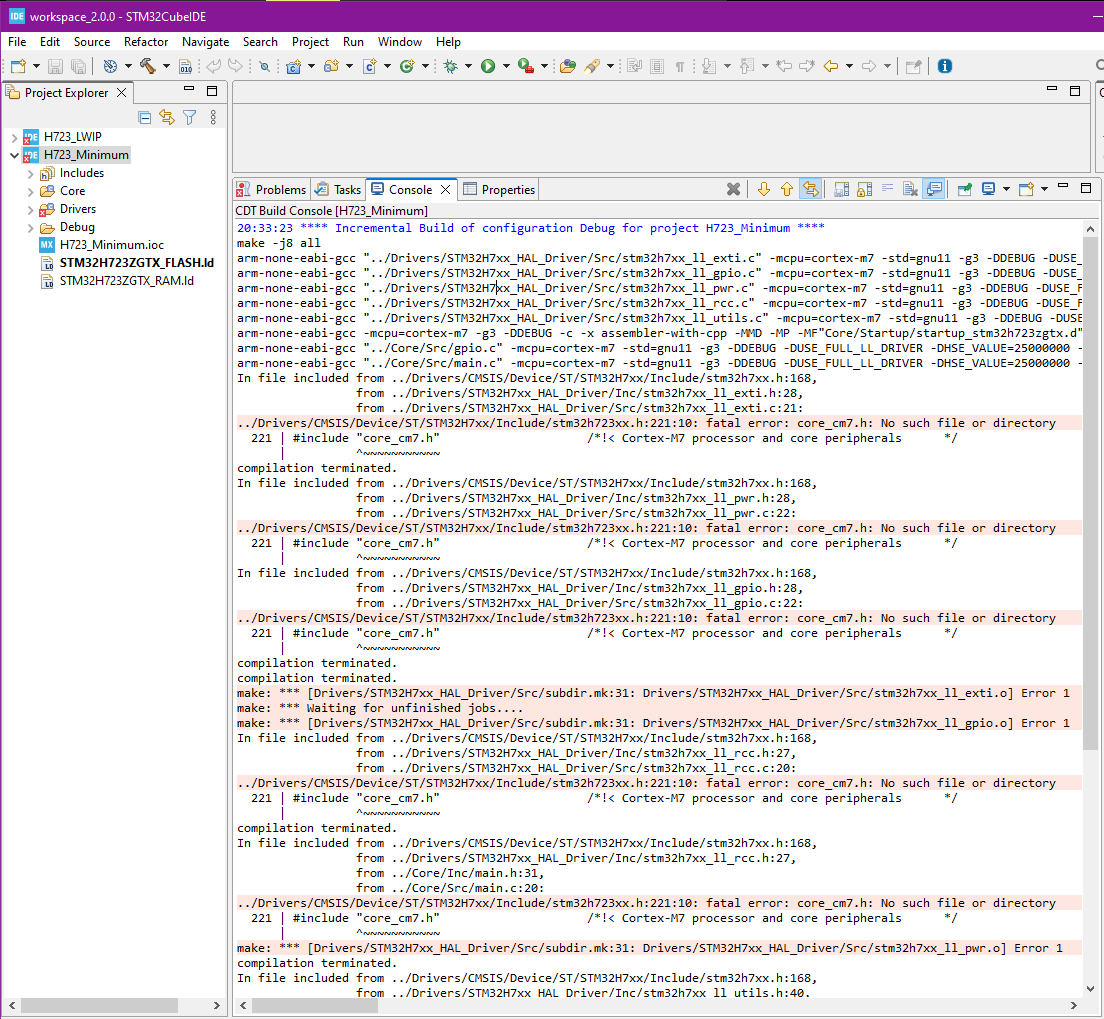
Fehlermeldungen in einer IDE beim Kompilieren
workspace 2.0.0 - STM32CubeIDE Problems Tasks Console Properties H723_LWIP STM32H723_GPIO.ax make -j8 .../Drivers/STM32H7xx_HAL_Driver/Src/stm32h7xx_hal_gpio.c:221 #include "core_cm7.h" No such file or directory compilation terminated. .../Drivers/STM32H7xx_HAL_Driver/Src/stm32h7xx_hal_rcc.c:28 #include "core_cm7.h" No such file or directory compilation terminated.
-
Thread
STM32 and SMBus
Hello everyone, I am trying to communicate with a MAX11068 from a STM32F103 over SMBus, but it does not work as expected. Has anybody worked with the SMBus and would be so kind to provide sample code? Michael
-
Thread
GDB issue (cortex-M3)
help: http://www.siwawi.arubi.uni-kl.de/avr_projects/arm_projects/arm_memcards/index.html#chanfat_stm32 During development I have used Eclipse Ganymede, CDT, CDT hardware-debugging-plugin, Codesourcery G++ lite for ARM-eabi 2009Q1, OpenOCD (different but rather up-to-date versions), Amontec JTAGkey, FTDI-drivers and STM32F103CB for the tests. Debugging from Eclipse works as expected (well, at least what I expected/needed). A little bit of additional information can be found in the readme.txt.
-
Article
Benutzer:Claus mueller
und privat beschäftige ich mich zur Zeit intensiv mit der Cortex-M0 (bzw. M0+) Reihe von STMicro (STM32F030 und STM32L051), ansonsten aber auch mit Cortex-M3 und ziemlich viel mit -M4. Über die Jahre hatte ich alle möglichen (PICs, 8051 von etlichen Herstellern, MSP430 und natürlich auch AVR) und unmöglichen
das Laden des Navigationgerätes verwendet. Als Steuerung dient ein µCortex-Modul bestückt mit einem STM32F030. Die Schaltung besteht im Grunde aus einem bipolaren Relais mit der zugehörigen externen Beschaltung, etwas Filterung, ein paar Mosfets und Schraubklemmen.
-
Thread
Circuit for STM32F401RDTx [ARM]
Hello, I am trying to design a circuit for the STM32F401RDTx. I proceed as per the datasheet, Application Note 4488 from ST, and Carmen Noviellos "Mastering STM32" , but I don't find it simple at all right now and have a few questions. I have attached
and all other supplies via a switch (per hardware or per software+fet or so). Usually all the STM32Fxxx have a built-in boot loader, so it's the best, to have on your maintenance connector some more signals: gnd, vcc, /reset, boot1 or boot0 (depends on the part. chip, so read the manual), txd1, rxd1
-
Thread
Interrupt handler in C++ File?!
Hi guy's I have the following problem. I'm using the STM32F103RB and Sourcery G++ Lite 2008q1-126 and I try to implement the Interrupt Handlers in a C++ File. I'm using C and C++ Code in my project and if I implement the handlers in a C File everything
You cannot do that as part of a class. I don't know the STM32, but my guess is that interrupt vectors are known by their global name, so they cannot be established using C++ name mangling. This also implies they cannot be hidden with in a class (class members
-
Thread
confused by various UDP checksum algorithms
hello forum, I am trying to send an UDP packet (contains only "TEST" string) from STM32 to VB6 winsock I can see packets going with wireshark software however winsock data_arrival subroutine never gets called ( if I send from laptop winsock to PC winsock or vice versa UDP packet
printscreen winsock cannot receive this packet I have an USRobotics adsl router between PC and STM32F4
-
Thread
Embeetle IDE free for all users, now supports Blue Pill and more.
and developed a visual debugger. Just recently, Embeetle IDE integrated the Blue Pill board. The STM32 Blue Pill is a 32-bit Arduino-compatible development board that features the STM32F103C8T6. A member of the STM32 family of ARM Cortex-M3 core microcontrollers. The STM32 Blue Pill board has nearly
-
Thread
how can I read protect my STM32F4 with eclipse + openOCD JTAG ?
hello forum , I am using Eclipse + openOCD JTAG for downloading and debugging my aplication into STM32F4 after I finish my project I want read protect my code so that it is not stolen question : how can I read protect my STM32F4 with eclipse + openOCD JTAG thank you
Please have a look at this chapters in the reference manual of the stm32F4xxx microcontrollers (RM0090): 3.6.3 Read Protection (RDP) 3.6.1 Description of user option bytes 3.8.3 Flash option key register (FLASH_OPTKEYR) And after that you should read in the documentation
-
Thread
how to flash/ update STM32 S76G firmware
to flash/ update the firmware (.dfu file) of my LILYGO TTGO T-Motion/softRF Dongle which runs on STM32 S76G Lora Chip by using DfuSe Demo Unfortunately the device is recognized as “STM32 BOOTLOADER” in Windows device manager instead as “STM Device in DFU Mode” What can I do to get this dongle
Auch wenn das schon ein alter Thread ist - der S76G enthält zwar einen STM32L073Z, ist aber nicht von ST. Es gibt jedoch Websites, die sich mit dem Flashen befassen, z.B. diese hier: https://dross.net/aviation/how-to-and-where-to-start-with-stratux/how-to-flash-a-softrf-ttgo-t-motion-from-lilygo
-
Thread
STM32 Virtual COM Port driver
based on Windows XP. The driver (inf-file) described at: http://www.mikrocontroller.net/articles/STM32_USB-FS-Device_Lib and available at: http://www.mikrocontroller.net/articles/Datei:Stmcdc.inf works fine when the host is based on Windows 2000, but we can not find this inf-file on the ST web-pages
-
Thread
Which microcontroller to use and how?
If you want something larger then I would recommend any ARM based microcontroller, for example the STM32F103 series which is available in different sizes). Regarding your current monitor: If you measre the current between power supply and voltage regulator then you measure the current consumption of
recommend to control the MAX5217 for the best results and more accurate? price is not important. the STM32F103 ?
-
Thread
STM32 GCC problem writing to flash bank 2
I am developing a project running on an STM32 target, using Eclipse, openOCD and CodeSourceryLite 2009q1-161. Part of the design is that the user should be able to upgrade the code in flash, so I partition it into a bootloader and two equal sectors
the code in the second sector. I was able to debug this code (using optimization level 0) on an STM32F103xD (which has 384K of flash) when unoptimized code was about 160K. However, the code has now grown to 220K unoptimized, 130K at optimization level 's'. Therefore I have been able to finish debugging
-
Thread
Networking Eclipse projects
Include' containing .c and .h files respectively. There is an additional file in 'Include' named stm32rom.ld which contains the processor characteristics needed by the linker. There is a third folder named 'obj' for the compiler and linker output files. The makefile on Server invokes the compiler
/stm32rom.ld: No such file or directory". I can't understand this, since the -T command format is exactly the same as the -I and compiler command formats, which are executed correctly. The makefile is
-
Thread
problem using adapter Olimex tiny-h with OpenOCD v0.4
Hi, I'm trying to get a fresh ARM-USB-Tiny-H adapter to program and debug my STM32-P103 board via OpenOCD v0.4 under Ubuntu 10.04. The configuration works fine with my older ARM-USB-OCD but with the Tiny-H, I always get this error: "Error: unable to set latency timer: 17" My
10.04 on Asus Eee PC (1Gig RAM, BNL Single Core) Interface: Olimex ARM-USB-TINY-H Target: Olimex STM32-P103 Evalboard Any clue what I might be missing? Gregor -- If its not playing with Tux, it's worth nothing.
-
Article
Linux auf STM32
Für dem Einsatz von Linux bzw. ucLinux eignen sich derzeit inbesondere folgende HW-Platformen: STM32F429I Discovery STM32F7 Discovery Folgendes youtube video zeigt beim STM32F429I Discovery die Verwendung des Displays mit touch und der seriellen Schnittstelle. Dieses Linux-Image kann z.B. unter einem
Linux-Host wie folgt erstellt und auf das Board installiert werden clone repository git clone cd stm32f429-linux-builder/ git checkout MovingTux cd .. install toolchain wget sudo tar -xjf arm-2010q1-189-arm-uclinuxeabi-i686-pc-linux-gnu.tar.bz2 sudo apt-get install genromfs install openocd git clone
-
Thread
How do you program arm processors? Locked
programmable with 'FlashMagic'. Use google, FlashMagic is free downloadable and usable. - The STM32Fxxx, programmable with: my own 'STM32Prog', downloadable on www.mikrocontroller.net, subforum 'projekte&code', also with old 'erfos' programmer, also with a piece of software from ST somewhat like
-
Article
IRMP
ATmega168, ATmega168P, ATmega328P XMega ATXmega128 PIC (CCS- und XC8/C18-Compiler) PIC12F1840 PIC18F4520 STM32 STM32F4xx (getestet auf STM32F401RE/F411RE Nucleo, STM32F4 Discovery) STM32F10x (getestet auf STM32F103C8T6 Mini Development Board) STM32 mit HAL-Library (NEU!) STM8 STM8S103F3 TI Stellaris LM4F120
keyboard converter. IRMP2Keyboard infrared remote to PS2/USB keyboard converter IRMP + IRSND Library für STM32F4. IRMP für STM32F4 IRSND für STM32F4 IRMP auf STM32 - Bauanleitung. Studienarbeit - Erweiterung der Arduino Plattform. Forumsbeiträge. Forumsbeitrag: IRMP und IRSND als Protokoll für 433 MHz Sender
-
Thread
Changing return address of exception
I am using olimex stm32 board. It has cortex-m3 processor. For my project, I require to change return address when processor is executing exception. I know that it is stored in stack, But where in stack? It is always
solved. I am writing the code to change return address which worked for me. This code is for olimex stm32f107 board. asm( "TST LR, #4;" "ITE EQ;" "MRSEQ R0, MSP;" "MRSNE R0, PSP;" ); asm("mov %0, r0" : "=r"(lraddr)); nxaddr=lraddr[12]; lraddr[12]=NEW
-
Thread
SD card lock and unlock
card support, you would see a "password protection". I use the MOTO E6 to lock my card, and use STM32F103VBT6 to unlock, then use STM32 to lock and E6 to unlock, both works well. I use the SPI mode. If I cound help you, please email chairang<at>126.com
-
Thread
STM32-MAT/TARGET
Hi, I am trying to generate sine modulated PWM on STM32F401-Disco board using MATLAB. The desired freq of a sine wave is 50Hz and of the carrier wave is 20kHz. But I am not getting 50Hz freq. Please suggest a solution. I need sine modulated PWM during
-
Article
IRMP - english
ATmega168, ATmega168P, ATmega328P XMega ATXmega128 PIC (CCS and XC8/C18 compiler) PIC12F1840 PIC18F4520 STM32 STM32F4xx (tested on STM32F401RE/F411RE Nucleo, STM32F4 Discovery) STM32F10x (tested on STM32F103C8T6 Mini Development Board) STM32 with HAL library (NEW!) STM8 STM8S103F3 TI Stellaris LM4F120 Launchpad
control: A MythTV Remote Control without LIRC. PC Remote Control with ATtiny85 IRMP + IRSND Library for STM32F4. IRMP for STM32F4 IRSND for STM32F4 IRMP on STM32 - Construction Guidance. Seminar Paper - Extension of Arduino Platform. www.eislab.fim.uni-passau.de/files/publications/2010/StudentDiener_ErweiterungDerArduinoPlattform.pdf
-
Thread
Atomic write - STM32
Hi, I'm currently working with a STM32F4 and try to implement atomic access to variables (e.g. mutexes). Currently, I disable all interrupts before accessing a mutex, and enable them afterwards. Now there exist the LDREX and STREX commands on the STM32, which seem to be perfect for my application. But how do I use them correctly? In the manual it says that an STREX *must* have the same address as the previous LDREX. So I still need to disable interrupts
-
Thread
Suggestion on controller selection
scanner or ohter input. Its just a thought and might be easier than a controller like e.g. the STM32F429 which has TFT driving, USB and e.g. SD Card ports. If you think about writing your own software from scratch, have a look at the Discovery Boards from STM, like the above mentioned F429 or the latest F7 series. http://www.st.com/en/evaluation-tools/stm32-mcu-discovery-kits.html?querycriteria=productId=LN1848