-
Thread
[STM32] Crossreference ChipID - Device (EN / DE)
people! Having had some trouble finding a decent source of information regarding the Chip ID on STM32 µCs and the Flash/Sram size, here's an appeal to gather known and tested information you all might have come across. As an example for what information should be in, at the end there's a snippet of
Morgen! Da ich auf wenig Information bezüglich CHIP_ID und deren Flash/Sram Speichergröße für die STM32 µCs im Internet gefunden habe, hier eine Bitte diese Information zu sammeln. Es sollten Daten sein die Ihr schon ausprobiert habt und getestet wurden. Als Beispiel am Ende ein Schnippsel der .xml Datei
-
Article
MP32F103-Stick: Ein Mini-Mikrocontroller-Board mit USB und bis zu 4MB Datenspeicher
nach Einarbeitung in diese Materie veröffentliche ich hier ein kleines Board mit dem Mikrocontroller STM32F103CBT6 von STMicroelectronics (www.st.com). Dieser Chip hat 128KB Flash, 20KB RAM, SPI, I2C, USART, USB, CAN, ADC und läuft bis 72 MHz. Das Board wird genauso aufgebaut sein wie mein MP2103-Stick:
gängigen Betriebssysteme vom Hersteller FTDI-Chip angeboten werden. Funktionsmodell. LINK: Datasheet vom STM32F103CBT6 LINK: st.com-Page vom STM32F103CBT6 LINK: Datasheet und Anwendung vom AT45DBxxx LINK: Datasheet vom TPS62203 Schaltplan. Herzstück des Boards ist der Mikrocontroller STM32F103CBT6 (IC1) mit
-
Thread
AVR Transistortester
can optionally set 5v on GPIO, which iirc would be of benefit. I saw other project that use the STM32 to lesser effect and seeing that the Flipper Zero uses the STM32WB55, I was curious if that could be leveraged too. welcoming any input, even if it's confirming this as a foolish idea.
-
Thread
mapping the exact input to the output
#include "stm32f0xx.h" #include "stm32f0308_Discovery.h" #define in0 GPIO_Pin_0 #define in1 GPIO_Pin_1 #define in2 GPIO_Pin_2 #define in3 GPIO_Pin_3 #define in4 GPIO_Pin_4 #define in5 GPIO_Pin_5 #define
-
Article
Diskussion:STM32 für Einsteiger
ist fatal und geht immer für den fertigen Arduino aus. Drehst du das Gewicht um, etwa ein wirklich STM32-relevantes Beispielprojekt in 60min und hängst die schmutzigen Details darunter an, ist der Artikel eine Hilfe. Bzgl. der Formatierung ist es ein ziemlich schwerer und sperriger Klotz. Bilder sind
Arduino. Der Artikel ist ziemlich zweifelhaft und erkennbar voreingenommen geschrieben von einem STM32-Fan. Falschaussagen sind auch vorhanden. Für AVR gibt es RTOSs aber für den Arduino nicht? Das muss mal erklärt werden, da der Arduino auch einen AVR nutzt.
-
Article
LPC1xxx für Umsteiger
diesem Artikel wird die 32-Bit Familie LPC1xxx von LPC kurz betrachtet. Die 32-Bit Controller der STM32-Familie werden in den Betrag STM32_für_Einsteiger und STM32 sehr schön vorgestellt, und sehr rudimentär mit dem LPC1xxx verglichen. Die aktuellen 32-Bit Controller (zumindest von LPC) kostet weniger
Installationsanleitung zur IDE LPC1xxx Codebase LPDXpresso Download (Kostenlos mit Debugger) LPCXpresso Homepage STM32 für Einsteiger
-
Thread
Problems with Yagarto/eclipse/gdb with JFlash Server
Hello, i am trying to connect J-Link with STM32L152D-EVAL board kit as a target device b ut i am getting the error (Error: STM32: connecting to CPU via connect under reset failed). Please give me some solution for this problem. thank you
-
Article
Benutzer:Mampf
alten aufarbeiten, in eine sinnvolle Form bringen und dann unter Projekt und Code veröffentlichen. STM32F429 DIY-Board. STM32F429 @ 168MHz 32MB SDRAM I2S Audio-DAC IR (derzeit unbenutzt) WLAN (ESP8266) µSD 2 USB (CDC, zweites Interface nicht benutzt) Software: Helix MP3-Decoder 7 Band (IIR) Equalizer
vollständig hinter der Röhre :) keine VFD-Spezialbauteile :) Kurzes Video: Mini-Word-Clock. Benutzt einen STM32F103 Hier noch ein kurzes Video zu V2.0: RGB Moodlight/Clock/Reminder. Spaßeshalber hatte ich mir überlegt, ein RGB Mood-Light zu bauen, da ich dafür einige verschiedene Verwendungszwecke habe. Außer
-
Thread
SPI communication between two microcontrollers
Hello everyone, I am trying to make communication between an STM32F3 microcontroller and a custom board baser on PIC microcontroller using SPI protocol. The STM32F3 acts as a Slave and the custom board as a Master. The clock is set to 10 MHz. I’m using NSS hardware
-
 Image
Image
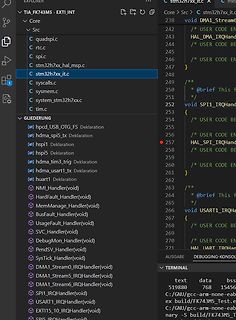
Code-Editor mit STM32 HAL-Treiberdateien
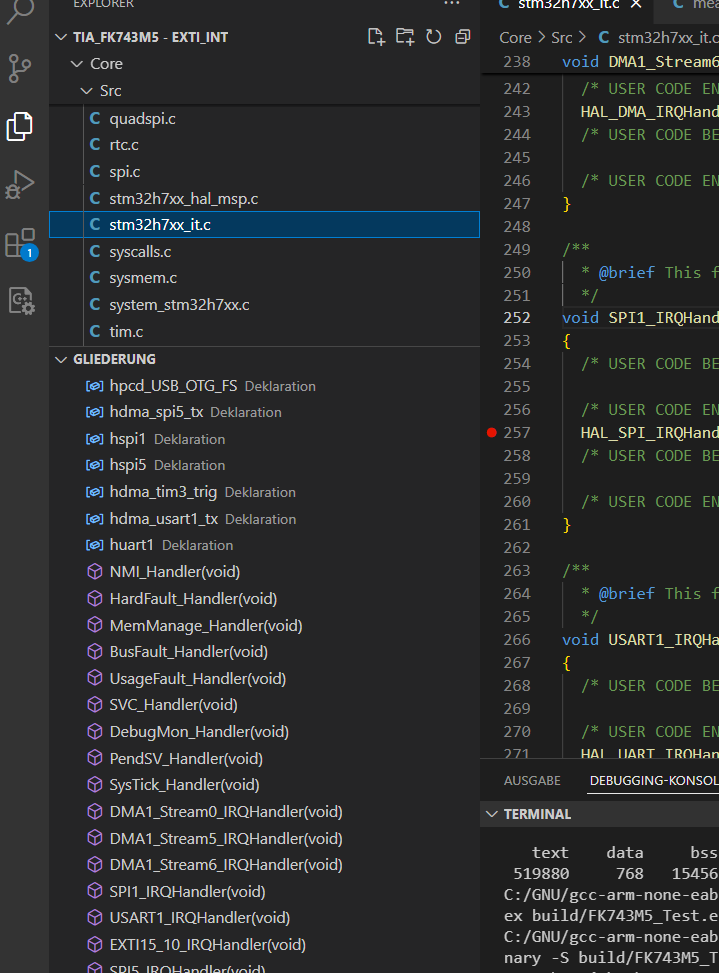
TIA_FK743M5 - EXTI_INT Core > Src > stm32h7xx_it.c quadspi.c rtc.c spi.c stm32h7xx_hal_msp.c stm32h7xx_it.c syscalls.c sysmem.c system_stm32h7xx.c tim.c GLIEDERUNG hpdc_USB_OTG_FS Deklaration hdma_spi5_tx Deklaration hspi1 Deklaration hspi5
-
Article
STM32 jump to bootloader
STM32 - Jump To Bootloader In manchen Anwendungen möchte man keinen Hardwarebutton für ein Firmware-Update haben. Muss man trotzdem ab und zu ein Update einspielen, kann man den Bootloader über eine versteckte
ein kurzes Python-Script, welches "GBL\r" sendet und danach wird direkt das Flash-Update-Tool wie stm32flash aufgerufen. So entfällt jegliches Bedienen am Gerät. Das Python-Script heisst gbl.py, danach der Aufruf zum flashen: $ ./gbl.py && stm32flash -b 921600 -w output/main.bin -g 0x0 /dev/ttyUSB0 Das
-
Article
Cortex M3 OCM3U
auf dem Board integriert. Aus Platzgründen habe ich auch den JTAG weggelassen, da der verwendete STM32F101 mit integriertem Bootloader daher kommt und sich über RS232 programmieren lässt, was für den Anfang reichen sollte. Zudem habe ich auch auf Sachen wie Spannungsregler und co. verzichtet, da hier
:OCM3U-rev-1.0.tar.gz UPDATE: 07.11.2008 Siehe auch. Diskussion zu diesem Projekt: NA Artikel zum STM32. Installation und Downlaods sind hier beschrieben. Links. ST(DB,Software,Exampels......): Examples: Infos und Architektur: Compiler von CodeSourcery: (EABI)
-
Article
Entscheidung Mikrocontroller
adaptiert werden. Diese PCB arbeitet hervorragend mit der kostenlosen Entwicklungssoftware zusammen. STM32. System Preis STM32F4DISCOVERY Demoboard incl. USB-JTAG/SWD Programmer & Debugger ~ 9..20€ Eine Umfangreiche Übersicht über die Funktionalitäten der STM32 µC sind im Artikel STM32 beschrieben. Viele Links zu Demo-Boards, Compiler, IDE's, Debugger sind im Artikel gesammelt. Ein µC Vergleich mit STM32 und andere sind im Artikel STM32 für Einsteiger gut zusammen gelistet. Programmübertragung. Im Idealfall stellt sich die Frage, wie das Programm in den Mikrocontroller kommt, für den Programm-Entwickler
-
Thread
ChibiOS on the STM32F4-Discovery
Hi, I got a STM32F4-Discovery board and wanted to test some ready to use code. I stumbled upon the ChibiOS and its STM32F4 support. I compiled the sources under macos x, with a self-built gcc, and flashed with a self-compiled
-
Thread
va_args, printf and DMA memory problems
past few days as I try to understand why and what is going on... So here it goes: Current config: stm32f407VG (same as stm32f4 discovery) I set up a project using the default linker and startup files from www.onarm.com. Init the ADC & DMA's [code] ADC_CommonInitStructure.ADC_Mode
-
Thread
GCC won't allow me to pulse flags
I am developing for a project an STM32 Cortex processor, using gcc on Eclipse. Initially I am working with the ST Electronics STM32F10x-128K-EVAL demo board, which included an LCD display and a joystick. I need to reset the backup domain
-
Article
UPlay Basic Interpreter per XMC2Go
gemacht hat, und es nicht sehr viel mehr Aufwand ist, werde ich das ganze wahrscheinlich noch auf eine STM32F4 CPU portieren. Dadurch sollte sich die Zykluszeit noch mal mindestens um den Faktor 5 erhöhen. Anmerkung: Inzwischen habe ich das Ganze auf die STM32F407, STM32F429 und STM32F756 CPUs portiert: 95-uBasic-Library (STM32F407) 28-uBasic-Library (STM32F429) 12-uBasic-Library (STM32F746) Anmerkungen. Wie immer bei "Bastelprojekten" können Fehler in der Hardware und Software nicht ausgeschlossen werden. Ich habe zwar viele
-
Article
Radar-Verkehrsmessung
Stückliste Name Beschreibung Distributor Bestell-Nr. Menge Stückpreis Preis Gesamt µC-Board NUCLEO-64 STM32F302R8 DigiKey 497-14594-ND 1 11,91 € 11,91 € LoRa-Modul RFM95W-868S2 DigiKey RFM95W-868S2-ND 2 15,81 € 15,81 € OPV für Vorverstärker ADA4841 DigiKey ADA4841-2YRZ-ND 3 6,89 € 20,67 € MOSFET FDV304P
LoRaWAN ist hier die LMIC Bibliothek von IBM für Arduino. Von dieser gibt es auch eine Version für den STM32, welche hier zu finden ist. Mithilfe des Videos lässt sich das LoRa-Modul mit dem STM32 verbinden und testen. In unserem Test konnten leider keine Pakete gesendet werden, lediglich die Authentifizierung
-
Article
USB-Tutorial mit STM32
der Software passiert. Für komplexe USB-Geräte oder eine schnelle Implementierung sei auf die im STM32CubeF1 enthaltene Bibliothek verwiesen. Es wird Grundlagenwissen über die Programmierung der STM32-Controller und über die C++-Programmierung vorausgesetzt. Zunächst wird ein "USB Hello-World" entwickelt
USB High Speed (480 MBit/Sec). Hier wird ein Controller mit der einfachsten Variante gewählt, der STM32F103RB. Dieser ist beispielsweise auf dem Olimexino-STM32 zu finden, im Folgenden wird dieses als Grundlage für die Beispiele genutzt. Der auf den günstigen Blue Pill-Boards zu findende STM32F103C8
-
Article
WordClock24h
-------------------+ +-------+ Das heißt, dass jeder zweite Streifen "auf dem Kopf" steht. Ab der STM32-Projektversion 1.5.8 werden bis zu 100 weitere LEDs hinter der Buchstabenkette als Ambilight unterstützt. Diese müssen einfach hinter der LED für den letzten Buchstaben in der Kette angeschlossen werden
bestückt, die Ansteuerung erfolgt wie bei den Stripes seriell. Elektronik. Als Mikrocontroller ist ein STM32F401 oder STM32F411 Nucleo Board vorgesehen. Dieses kostet ca. 12 EUR und mit 512KB Flash und mindestens 96KB RAM genügend Reserven. STM32F4xx Projekt. Die Beschreibung des STM32-Projekts wurde auf
-
Thread
STM32F0 WITH STPM34
Hi everyone, I am working a project (stm32f0 with stpm34 ic measurement power). Could you help me interface stm32f0 with it. Thanks!
-
Thread
STM32F4 IMPRECISERR, trouble debugging
First off I did make a Debug Fault Handler, this is what I am getting r0 = 1200 0x000004B0 r1 = 0 0x00000000 r2 = 1200 0x000004B0 r3 = 1 0x00000001 r12 = 0 0x00000000 lr = 134228401 0x080029B1 pc = 134228410 0x080029BA psr = 553648128 0x21000000 OST = 536881104 0x200027D0 HFSR = 1073741824 0x40000000 CFSR = 1024 0x00000400 Showing BUSFAULT IMPRECISERR DFSR = 0 0x00000000 MMFAR = 3758157108 0xE000ED34 BFAR = 3758157112 0xE000ED38 AFSR = 0 0x00000000 PSP = 536881200 0x20002830 SHCSR = 0 0x00000000
-
Article
USB
PWM 2 USART, 2 CAN SPI, I2C, SSC SD/MMC, Ethernet 10 Mbit, Businterface, JTAG Digikey ca. 8 € ST STM32F10x Full 36..144 3,3V/5V Cortex-M3 72MHz 512KB 64KB 21 x 12bit 2 x 12bit, 32 PWM 5 USART, 1 CAN SPI, I2C, SSC Siehe Artikel STM32 Farnell ab ca. 5 € ST STM32F4xx Full + Hi 64..176 3,3V/5V Cortex-M4
engineersgarage.com - 6 teiliger USB-Artikel USB in a NutShell - Making sense of the USB standard USB-Tutorial mit STM32
-
Thread
Convert YUV(4:2:2) format to BMP file by use of OV9655 image sensor
Hello anyone I working on OV9655 camera module that is connected to stm32f4discover evaluation board. I am able to capture a picture from the OV9655 module where the video output format is based on RGB565 and save as BMP file on SD cart. Now I want to capture a gray scale
sure about that above setting for OV9655 is correct. After the picture is grab by used of DCIM on STM32F407 microcontroller do I want to convert it to BMP file. Right now do I use the same code that is use during conversation of RGB565 to transform YUV(4:2:2) format to BMP file. The code work fine during
-
Thread
Ebike Lishui controller, custom FW, problem at certain voltages
Hi fellows, I have a strange problem with ebike controller using STM32 uC (Device family :STM32F10xx Low-density) I have a fischer 1606 ebike with a Lishui controller which did not have original display. I found that this controller has alternative firmware made by
-
Article
Datei:Stm32 aufbau.jpg
STM32F103xC STM32F103xD STM32F103xE High-density performance line ARM-based 32-bit MCU
-
 Image
Image
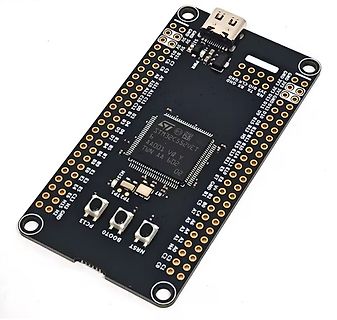
STM32 Mikrocontroller-Entwicklungsboard
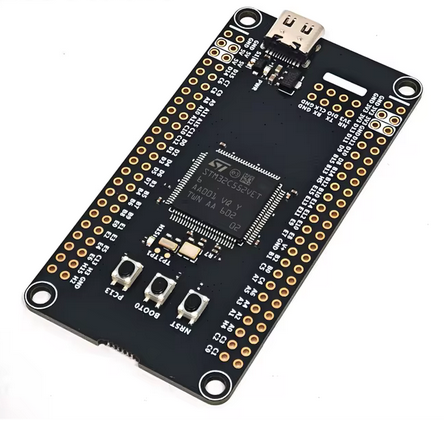
STM32C552VET AA001 V4 Y TWIN AA 605 20 NRST BOOT0 PC13 GND 3V3 5V USB
-
Thread
embedding C source in the disassembler window
Anglia Electronics kindly sent me an Eclipse version of the STM32demo project. It includes a custom makefile, so it doesn't use any outside resource such as Solaris to create the makefile. I am trying to create my own project to emulate this with good success
system, because it now fails at the end of compilation with the message 'cannot open map file obj\stm32demo.map' I am now getting extremely frustrated with Eclipse. I want to use it as a tool for developing a project to run on embedded hardware, but I am spending more time trying to fix the tool
-
Thread
Creating blank new C-Project with Yagarto chain for ARM7
tested tool after tool (open source and commercial) to find something to start work with cortexM3 (STM32F10x) immediately. No chance. The reasons: no install package, no documentation, missing scripts for my device, no debug, no linker, no thumb2-compiler, specific debug-tools, expensiv, only 30 days
and, and. Then I found lots of simple example projects of different users here: http://www.stm32circle.com/projects/index.php I installed Ride7 and within one day my own test board was blinking. Next day I tested debug on the primer2 - OK. Ride supports most ARM7 and cortexM3 from NXP and
-
Article
Mikrocontroller Vergleich
8051: Keil MCBx51 (z. B. für ~240 von mouser.com) ARM: allgemein: (z.T. hier im Shop erhältlich), STM32 STM32 Discovery Board für ca. 20 Euro NXP Entwicklungskit LPCXpresso-Entwicklungskits (PDF) für ca. 25 Euro Infineon XMC4500 Relax Kit für ca. 10 Euro EFM32 Energy Micro Starter Kit ab ca. 55 Euro
Betriebsspannungen benötigt; Tendenz aber fallend. Links. Forum 8051 ARM AVR EFM32 LPC1xxx MSP430 PIC R8C ST7 STM8 STM32 Z8 Z8_encore! Vergleich (Original in englisch von Jay Carlson) Vergleich (in deutsch übersetzt)
-
 Image
Image
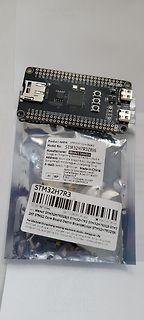
STM32H7R3 Development Board in Verpackung
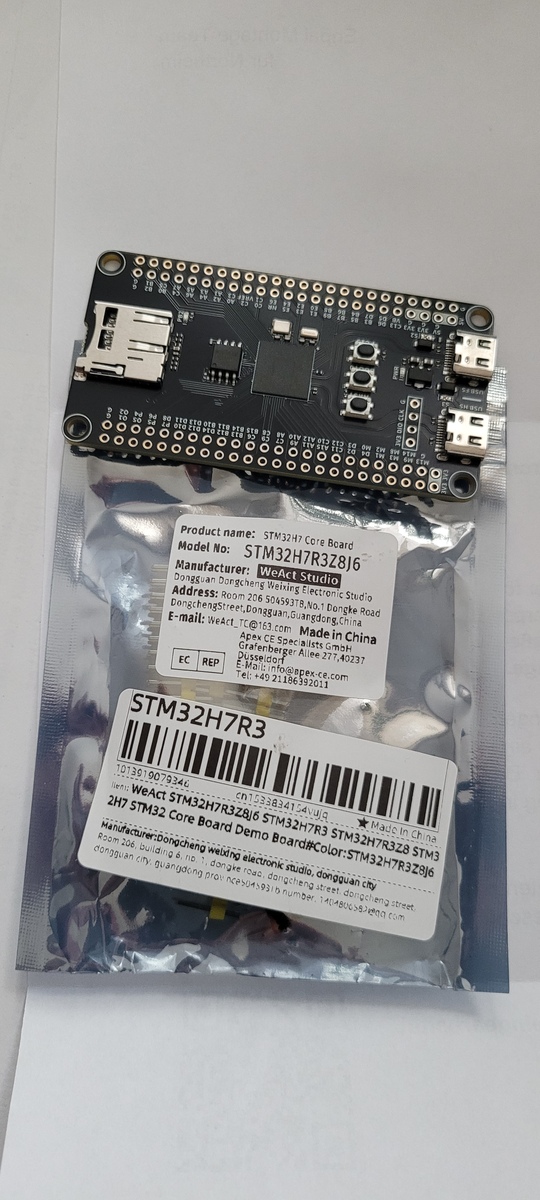
Product name: STM32H7 Core Board Model No: STM32H7R3Z8J6 Manufacturer: WeAct Studio Address: Donggan Dongking WeActking Electronic Studio Made in China E-mail: WeAct.TC@163.com STM32H7R3
-
Article
Diskussion:STM32 Eclipse Installation
Könnte jmd herrausfinden, ob das ganze auch per ST Link mit den Eval Boards möglich ist?
-
Thread
How to stop breaking at reset
I am developing a number of projects for STM32 processors using Eclipse, gcc, gdb and an Olimex ARM-USB-OCD jTag dongle. All works well, but every time I relaunch the project in debug mode the code stops at address 0x08000000. The debug window
this always happens. Furthermore I suspect it is using up one of the 6 breakpoints provided by the STM32, which restricts debugging. I launch gdb with the following commands: target remote localhost:3333 monitor reset init load monitor reset init break main The first breakpoint it should
-
Thread
STM32F103VET6 und CH340R
I have a problem with my PCB. I recieved it a few days ago and it is already completly presoldered. If i connect it via USB-TYPE B to my pc it is showing me nothing in device menager.... The CH340G should be visible to be able to programm it via usb.... If i connect it via micro-usb unknown device is popping up. But that does not help me :). I have added the schematic. Hope someone can help me.
-
Article
Linksammlung
and microcontrollers, ranging from 8 bits to 32 bits CPUs and even PCs. ChibiOS/RT Circle-OS for STM32 Kostenloses OS, sehr klein mit Basisfunktionen fuer STM32 CoOS eCos - "Real-Time-Operating-System" o.a. auch für ARM7 FreeRTOS (.org!) - "Real-Time-Kernel" unter anderem für ARM7 (LPC2xxx) auch AVR
Header-Boards (LPC2000, STR7, AT91SAM, ADI, TI, OKI u.a.) Propox Primer2 from Raisonance Focus auf STM32 mit sehr grossem Forum im STM32circle Revely Evaluations- und Demo-Boards mit Sharp ARM Controllern. Teilweise mit SVGA-Anschluss. SKPang electronics Entwicklungsboards für diverse ARM7/9 (UK) SSV
-
Article
Versaloon
Versaloon ist eine open source Plattform fuer den STM32, welche auf einem generischen USB-zu-XXX-Protokoll basiert. Zur Zeit werden mehr als 10 Schnittstellen wie JTAG, SWD, SPI oder I2C unterstützt. Unterstützte Zielarchitekturen. STM8 (SWIM) STM32 (ISP
(BDM) HCS12(X) (BDM) SVF (JTAG) Unterstützte Hostplattformen. STM8S-Discovery (Onboard-Debugger) STM32VL-Discovery (Onboard-Debugger) siehe auch Forumsbeitrag von Bingo Versaloon Nano Versaloon Mini Versaloon Handy PC-Software. Firmware. Downloads. Siehe auch. Versaloon ist offenbar tot, die oben angebene
-
Thread
STM32H7 real-time data tracing via SWD not working
oscilloscope (No edges detected) -Reading STLINK Jumpers with oscilloscope (Edges detected) -Other IDEs SW4STM32 (No success) -Serial wire viewer of STLINK (nothing shown) -Tried debugger and builder / optimization settings. (Still no success) See screenshots for detailed description and the configurations
real-time* trace data. But anyway, look there: https://community.st.com/s/question/0D50X00009XkhURSAZ/stm32h7-swo-printf-not-working
-
Thread
Layered OS: DMA Transfer into Filesystem
of which one is to learn PS: even though this question is more a theoretical one, I use C on an STM32 --- German: Hallo, ich programmiere ein Betriebssystem* für mein aktuelles Projekt und hab jetzt ein kleines Problem. Das OS ist "layered", also mit Schichten aufgebaut. Es gibt ein HAL
lernen möchte. PS: Auch wenn das eher eine theoretische Frage ist: Ich programmiere in C für einen STM32
-
Article
ARM-ASM-Tutorial
development boards with these controllers are available, for example: Nucleo-F103, “Blue Pill” (search for “stm32f103c8t6” on AliExpress, Ebay or Amazon), Olimexino-STM32, STM32-P103, STM32-H103, STM3210E-EVAL. Processor type & documentation. First, the microcontroller manufacturer’s documentation is used to find
customary to name the linker script after the controller they are intended for, so create a text file “stm32f103rb.ld” or “stm32f103c8.ld” with the following contents: Example name: “LinkerScriptSimple” This is this minimum viable linker script for a microcontroller. If you are using a STM32F103C8, replace
-
 Image
Image
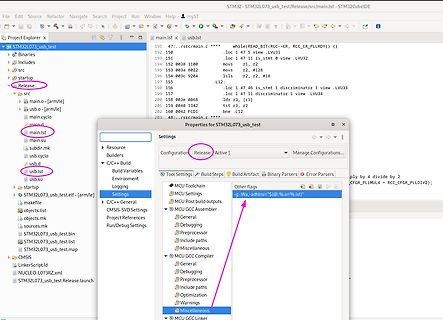
Screenshot einer Software-Entwicklungsumgebung mit Projektstruktur und Einstellungen
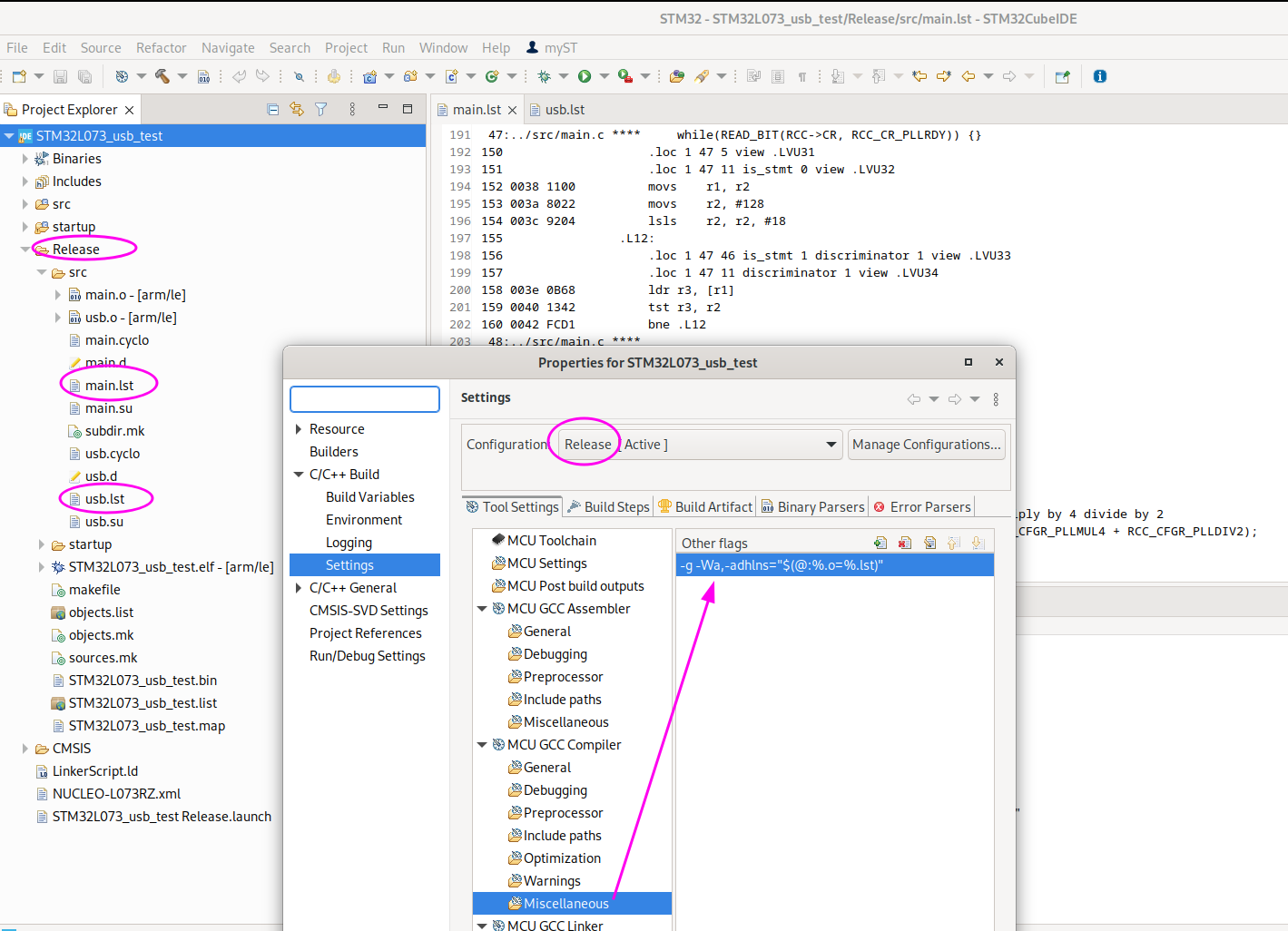
STm32-STM32L073_usb_test/Release/src/main.lst-STM32CubeIDE Project Explorer main.lst x usb.lst x main.c while(READ_BIT(RCC->CR, RCC_CR_PLLRDY)) { .loc 1 47 5 view .LVU31 .loc 1 47 11 is_stmt @ view .LVU32
-
Thread
Strange SPI-Interrupt behaviour with STM32F107
Hi, I am working on a spi-driver implementation for STM32F107. Things seem to work quite well, but I get sporadic interrupts on SPI with only the BSY-flag set. No other flags like TXE,RXNE, etc. are set. Here is my interrupt handler for spi(it is called
solved the problem that u had. Could u please provide me with the source code of the spi-driver for STM32F107. Thxxx a lot. Cheers, Angela